
RAMEKON O’ARWISTERS: LIBERATED FRAGMENTS
| by Maria Rosaria Roseo |
Ramekon O’Arwisters, born in Kernersville, North Carolina, and currently based in San Francisco, brings to his artistic practice a rich tapestry of experiences that intertwine autobiography, political reflection, and spirituality. Trained with a Master of Divinity at Duke University in Durham, the American artist has chosen art as a vehicle for an intimate yet universal narrative, capable of addressing pain, frustration, acceptance, and liberation.
His works are accounts of courage and critical thinking, deliberately distanced from collective indoctrination, rooted in the understanding that matter, while retaining its phenomenological characteristics, can shift in meaning through the transformative action of the artist. Broken ceramic fragments and discarded textiles are stripped of their original function and assume a new role. In his early series, fabric appears to envelop and mend what has been broken, but over time—as the artist himself notes—these works have transformed from “something broken, needing mending, to something fully determined and self-aware.”

O’Arwisters recounts that during his childhood in the 1960s and 1970s, drawing and painting provided a secret refuge, a means to conceal his queer identity from his parents. Knowing they would not approve of a child who did not meet heterosexual expectations or show interest in “masculine” activities such as sports, he spent hours at the kitchen table immersed in homework, drawing, and painting, confident that this dedication would shield him from unwanted questions and the dangers faced by Black Americans under the threat of police brutality. His early works — geometric patterns devoid of narrative content — were beautiful yet intentionally empty, a way to exist without revealing himself.

For much of his career, he surrendered his autonomy, seeking approval from the gatekeepers of the white art world — curators, gallery directors, museum administrators — questioning whether his work was “valid” or “worthy.” At a decisive point in his journey, he chose to break this cycle: after decades, he realized that the art system was not designed to support Black artists, but to preserve the status quo. He then decided to pause, reflect, and reconnect with his family roots. Memories of quilts made by his mother and especially his grandmother returned — improvised creations, rich in contrasting colors, reminiscent of jazz — a metaphor for the capacity, typical of Black life in the United States, to elevate the spirit within a hostile context and to navigate challenges through improvisation.
From these roots emerged the practice that has defined him: sculptures intertwining ceramic fragments and discarded textiles. The artist sees in these “marginalized” materials — waste, objects destined for the landfill — a reflection of how American culture treats marginalized people: ignored, mistreated, considered disposable. Broken ceramics and fabrics become substitutes for these “disposable” lives, acts of resistance and testimony. In early works, fabric enveloped and repaired, but over time the pieces gained autonomous identity: “the works have transformed from something broken, needing mending, to something fully determined and self-aware,” he asserts.

His sculptural production marks stages of coherent and radical evolution. Mending (2016) draws on childhood memories of sewing quilts with his grandmother, where he felt “welcomed, important, and special,” combining broken household ceramics with crochet. In Cheesecake (2019), the artist embraces the complexity of a term used to objectify attractive bodies, subverting its derogatory connotation: glamorous, small-scale sculptures in which decorative fabrics and donated ceramics merge into bold coming-of-age works. During the pandemic, with Flowered Thorns, O’Arwisters wove sharp ceramic fragments and torn fabric into totems that embody drag haute couture and the African American quilting tradition, overturning the symbolism of thorns as metaphors of sin to restore them with liberatory value: “the difference that gives purpose and meaning.”


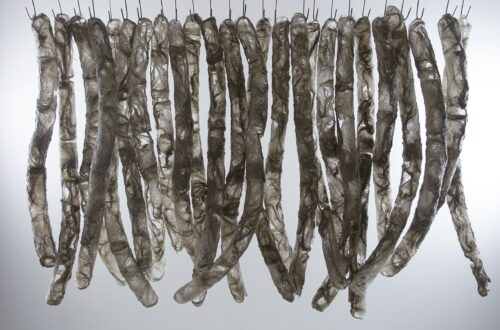
In recent years, his practice has incorporated a new material: animal hide, chosen for its primordial connection to human skin and its evocative power. The Black on Black and Patent on Patent series combine hide, broken ceramics, clamps, and metal fasteners to convey a world increasingly perceived as restrictive, controlling, and socially and politically oppressive.


These works converge in a pivotal new chapter: SCHISM, O’Arwisters’ first solo exhibition at Patricia Sweetow Gallery in downtown Los Angeles, held from September to October 2025.
The term Schism — fracture, division, dissonance — does not suggest an internal conflict, but an awareness of the fragility and rifts defining the present: from personal relationships to political, religious, and community structures. For those who are Black and queer, like O’Arwisters, being monitored, controlled, and subjected to coded responses is not new, but historically ingrained.
The exhibition translates these themes into a landscape of “coded abstraction,” where woven leather sculptures from the Black on Black series, large-scale Bound in Black tapestries, and a selection of black-and-white self-portraits compose a narrative of resistance. The tapestries in particular reach toward a collective memory beyond individual biography: their title references the secret language of the Underground Railroad, the clandestine network that, in the nineteenth century, helped thousands of enslaved people escape, hidden “under boards and rags,” the so-called “packages bound in black.”


In the works of Schism – rounded leather pouches, straps, torn fabrics, and ceramic fragments – diverse materials converge into totems that evoke Black culture, drag, African American quilting, and a resilient, defiant spirituality. O’Arwisters creates a dialogue of contrasts – abyss and beauty, wound and grace, memory and metamorphosis – transforming these tensions into a visual language that neither comforts nor simplifies, but demands engagement with the fractures of the present, where difference becomes both power and meaning.