
THREAD: AT SARAH MYERSCOUGH GALLERY, THREAD AS A LANGUAGE BETWEEN MATERIAL, MEMORY, AND CONTEMPORARY PRACTICE
London-based Sarah Myerscough Gallery (18 Balderton Street, Mayfair, London) presents “Thread”, a group exhibition hosted in the Upper & Lower spaces of the Schoolhouse, on view from 27 March to 14 May 2026. The exhibition brings together an international group of artists engaged in exploring thread as material, concept, and expressive tool.

Long recognized for its pioneering role in championing material- and process-driven artistic practices, the gallery uses this exhibition to offer a broad, layered reflection on weaving understood not merely as a technique, but as a language capable of embodying deep connections between human experience, memory, and culture.

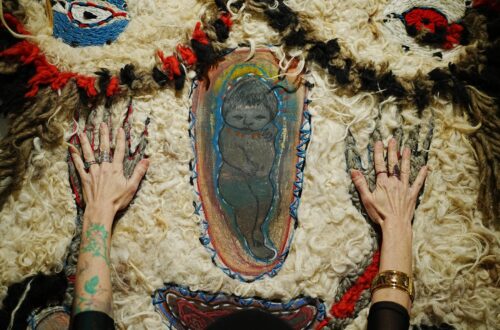
The works on display range from large-scale wall tapestries made of wood to sculptures composed of metallic filaments, as well as organic structures that evoke naturally grown root systems. Together, they outline a landscape in which traditional materials and contemporary experimentation meet and interact. This international survey of contemporary textile-based work highlights how an ancient practice, through the use of natural fibers and innovative techniques, continues to reflect dynamics of cultural exchange and shared creativity, giving rise to a poetic and universal language capable of transcending the conventional forms of modern communication.

The exhibiting artists include Dana Barnes, Patrick Bongoy, Ann Coddington, Aude Franjou, Lin Fanglu, Teresa Hastings, Wanbing Huang, Tim Johnson, Taylor Kibby, Alida Kuzemczak-Saye, Kate MccGwire, Adriana Meunier, Annette Mills, Arko, Joana Schneider, Diana Scherer, Wycliffe Stutchbury, Amy Usdin, and Lucy Williams. They work with a wide range of materials such as plant roots, metal, rubber, washi paper, bamboo, linen, feathers, recycled fishing nets, regenerated viscose, cotton, raffia, and reeds, demonstrating how textile practice can extend beyond its traditional boundaries to encompass ecological, technological, and symbolic references.

In her critical essay, Emma Crichton-Miller notes that the word “thread” is etymologically rooted in the idea of twisting, and that through this fundamental gesture it becomes a generator of narrative and structure: “with a thread one can begin to tell a story,” she writes. She further emphasizes how weaving historically predates written language and is intimately connected to the human body—from the first swaddling of a newborn to the funerary shroud. Crichton-Miller highlights how these symbolic and historical resonances remain central to the artists featured in “Thread”, who, coming from diverse disciplines such as painting, drawing, fashion, and weaving, share a common interest in the capacity of thread to shape thoughts and emotions and to open narrative spaces, much like a drawn line that develops and unfolds within space.


The exhibition aligns closely with the mission of Sarah Myerscough Gallery, founded in 1998 and internationally recognized for promoting artists working at the intersection of craft, design, and sculpture, with a particular focus on the relationship between traditional practices and innovation. The gallery’s program is distinguished by its commitment to works that express a deep engagement with natural materials – often wood – and that address environmental, social, and cultural themes through a conceptually rigorous and technically sophisticated approach, fostering an ongoing dialogue between artists, curators, and institutions, and contributing to the expanding role of craft within the contemporary international art landscape.