
PARNASSUS BY LETIA – LETIZIA CARIELLO AT GAM MILAN
Through July 5, 2026, GAM Galleria d’Arte Moderna presents Παρνασσός Parnassus, a new site-specific installation by LETIA – Letizia Cariello, on view in the museum’s historic Sala del Parnaso. The project marks the first public museum presentation in Milan of the artist’s work, developed in the city where she has lived and worked since her formative years.

The installation takes the form of a large, lightweight architectural structure in golden aluminum: an open framework that can be visually crossed from every angle, conceived in constant dialogue with the room’s neoclassical setting and the garden visible through the villa’s windows. More than a self-contained sculpture, the work functions as a mental and perceptual space, suspended between domestic dimension and symbolic construction.

For years, Cariello’s practice has focused on themes of time, energy, and the relationship between inner space and physical space. In Παρνασσός Parnassus, these elements converge in an environmental installation that invites visitors to continuously shift their perspective. The transparency of the structure and the lightness of its form become tools for reflecting on the possibility of making time visible through matter, light, and movement.

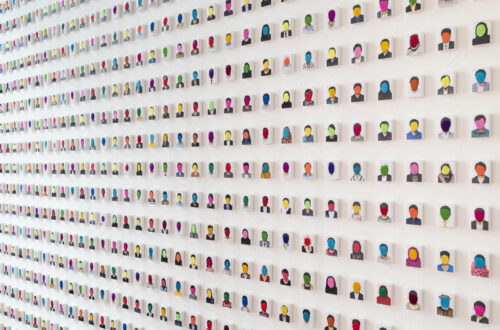
The installation incorporates several recurring elements from the artist’s visual language, including rotating calendars mounted on circular frames and a suspended globe made from screen-printed wallpaper and dried roses collected from the GAM garden. Constructed with thin curved wooden ribs and completed by an oversized hanging tassel, the globe introduces a visual tension between geometric order and organic deviation.
The work was conceived in close relation to the Sala del Parnaso itself, dominated by the 1811 ceiling fresco by Andrea Appiani, the artist’s final masterpiece. Dedicated to Apollo and the Muses on Mount Parnassus, the fresco is considered one of the defining works of Italian Neoclassicism and here becomes a direct counterpart to Cariello’s contemporary intervention. The artist also revisits the etymological origin of the word “Parnassus,” linking it to the ancient Anatolian root parna, meaning “house” or “dwelling,” reinforcing the idea of the installation as both inhabitable space and mental passage.
Music also plays a central role in Cariello’s practice. On May 21, the Sala del Parnaso will host a concert by Le Dimore del Quartetto, conceived not as a side event but as an extension of the installation itself. Performed in two public sets, the concert will allow visitors to move freely through the space while sound and architecture reshape the perception of the work.

The musical program will connect neoclassical references with contemporary reflections on time and infinity, pairing compositions by Wolfgang Amadeus Mozart and Ludwig van Beethoven with the immersive dimension of the installation. In this way, Παρνασσός Parnassus expands its nature as an experiential environment, transforming the gallery into a kind of resonant chamber where visual perception, memory, and listening coexist.

The exhibition is accompanied by a catalogue published by Silvana Editoriale, featuring critical essays focused on the artist’s research and on the relationship between artwork, architecture, and museum space. Opening hours, Tuesday to Sunday, from 10 am to 5:30 pm.