News
-
ELENA REDAELLI PRESENTS INTERTIDAL CARAPAXIA – WETLAND FUTURE FOSSILS AT THE 2026 SIANGSHAN WETLAND ART FESTIVAL
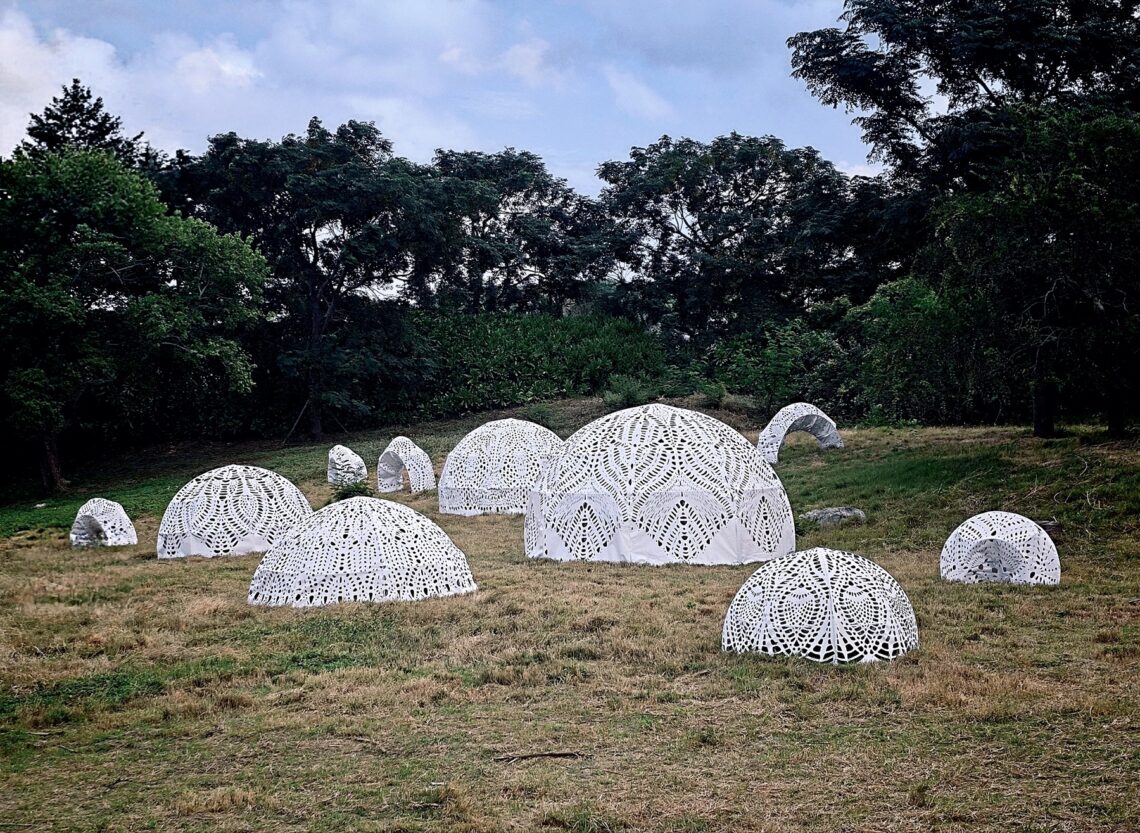
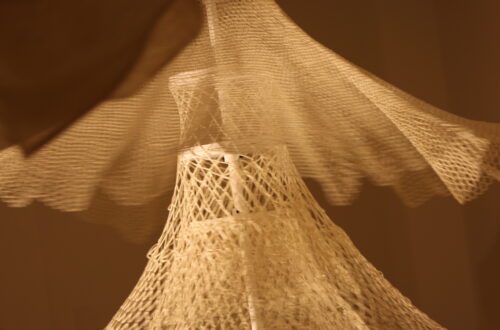
Recycled advertising banners become the white, perforated skin of an imagined organism, inviting attention to the fragile ecology of Hsinchu’s coastal wetland. Visual artist Elena Redaelli presents Intertidal Carapaxia – Wetland Future Fossils, a large-scale, site-responsive sculptural installation at Siangshan Wetland Natural Park. The work is part of the 2026 Siangshan Wetland Art Festival, on view from 2 October to 1 November 2026. Inspired by Taiwan’s endemic fiddler crab and the microscopic architectures of diatoms, Intertidal Carapaxia takes the form of a mysterious organism emerging from the landscape. Modular metal structures support white membranes cut from discarded advertising banners. Their perforated surfaces recall crochet, translating a familiar textile language into…
-
DE TOUTES BEAUTÉS: TEXTILE ART REANIMATES A HISTORIC MANUFACTORY IN AUBUSSON
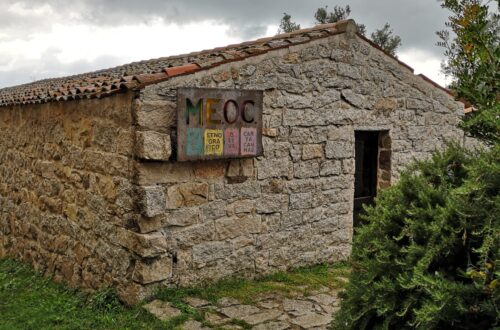
From 9 to 31 October 2026, a historic manufactory in Aubusson will once again become a meeting point between textile heritage and contemporary artistic research. The ancienne Manufacture de tapisseries Fougerol, at 67-63 rue Jules Sandeau, will host De toutes beautés, a group exhibition conceived by Les Ateliers de la Main Nue and Les Nouveaux Ateliers Fougerol as part of the Biennale d’Art Textile (FITE) de Clermont-Ferrand. The opening will take place on 9 October, from 5 to 8 pm. The exhibition stems from a desire to intervene in a site deeply connected to the history of French weaving, transforming its spaces into an exhibition route unfolding across interiors, shop…
-
RHYTHM AND VARIATION: WEAVING AS AN OPERATIVE FORM OF MEDITATION AND EMBODIED THOUGHT
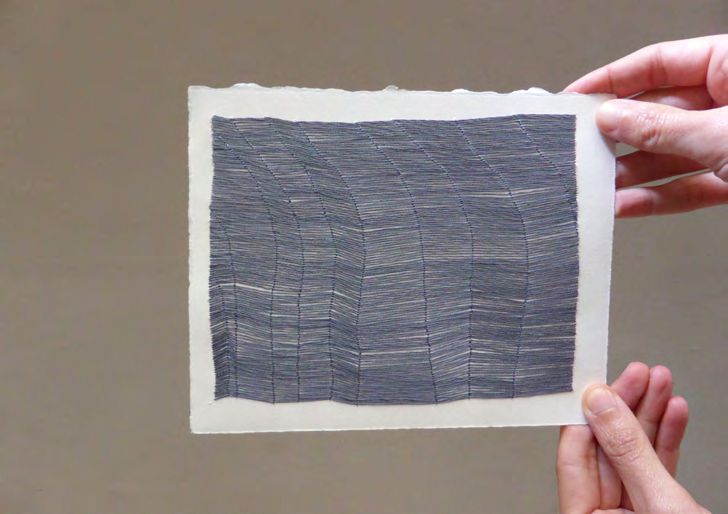
| by Eleonora Giglione | In textile work, repetition is often interpreted as automatism: a sequence of gestures without deviation. Yet, on closer inspection, weaving challenges this reading. The thread does not simply pass back and forth; each gesture introduces a minimal variation, a difference that accumulates over time and reshapes the whole. Repetition does not eliminate complexity, it produces it. In Japanese weaving, for example, techniques such as kasuri, in which threads are dyed before weaving to create intentionally offset patterns, require an extremely controlled repetition that can never coincide with identity. The pattern emerges from a sequence of repeated gestures, yet the slight misalignment of the threads introduces a…
-
SAN DIEGO’S VISIONS MUSEUM OF TEXTILE ART ACQUIRES CORONA DE PLUMAS BY DEBORAH KRUGER
The Visions Museum of Textile Art (VMOTA) in San Diego has announced the acquisition of Corona de Plumas by Deborah Kruger into its Permanent Collection, reaffirming the museum’s commitment to advancing some of the most compelling contemporary practices in fiber and textile art. Originally presented in Interpretations 2025, the museum’s international biennial dedicated to contemporary textile art, the work has now entered the collection through the generous gift of an anonymous donor. The acquisition reflects VMOTA’s ongoing interest in artistic practices that bring together formal experimentation, material research, and critical engagement with today’s environmental and cultural challenges. As VMOTA Executive Director Katrina Bruins noted, the acquisition of Corona de Plumas…
-
THE TEXTILE AS A LIVING ARCHIVE
| by Eleonora Giglione | When addressing the preservation of textiles, a common prejudice emerges: that fabric, being biodegradable, cannot endure like “durable” materials such as marble or bronze. This view stems from a factual observation: most ancient textiles have not survived because organisms, light, humidity, and oxidation degrade them more rapidly than stone. Yet material history shows that, under favorable conditions, textile artifacts can survive for millennia and provide analytical evidence comparable to that of a sarcophagus or a relief. The Tarkhan Dress, a linen garment found in Egypt and dated between 3482 and 3102 BCE, preserved at the Petrie Museum of Egyptian Archaeology in London, is considered the…
-
IN FOBELLO, COMMUNITY AND ART ARE WOVEN TOGETHER: PAOLA ANZICHÉ’S ARTIST RESIDENCY COMES TO A CLOSE
A village square transformed into a giant loom, dozens of hands at work, and a single large textile created collectively. This was how Paola Anziché’s artist residency concluded on 27 June 2026 in Fobello, a small mountain village in Valsesia, Italy, with Maglia in Comune (Knitting Together), a participatory project that brought together residents, visitors, and tourists to create a life-sized circular knitted structure. The event marked the public culmination of the artist’s research residency, developed as part of Fobello. The Tradition of Innovation, a cultural and social regeneration project. At the heart of Anziché’s investigation was weaving as a relational practice – one capable of generating connections, fostering dialogue…
-
THE INTERNATIONAL TRIENNIAL OF TEXTILE ARTS IN SZOMBATHELY TOWARDS 2027: NEW DIRECTOR ESZTER SÖPTEI ON ITS HISTORICAL LEGACY AND FUTURE DIRECTIONS
| By Barbara Pavan | Within the international landscape of contemporary textile practices, the International Triennial of Textile Arts in Szombathely has established itself as a leading reference point. Hosted by the Szombathely Gallery (Szombathelyi Képtár) and organized in collaboration with the Savaria Museum and the Cultural Foundation for Textile Arts, the event represents one of the longest-running and most authoritative platforms dedicated to textile research in Central and Eastern Europe. As such, it offers a privileged perspective on the transformations that have shaped the textile medium from the second half of the twentieth century to the present day. Founded during the remarkable flourishing of Hungarian textile art in the…
-
TEXTILE AND SOUND, BEYOND NOTATION. VIBRATING MATERIALS, LISTENING SURFACES
| by Eleonora Giglione | Not everything that sounds asks to be written, and not everything that is written truly holds a sound. The distance between vibration and sign, long shaped by musical notation, begins here to loosen without needing to be denied. It is enough to shift attention, away from what represents, toward what responds. Textile belongs to this second condition. It is not a neutral support, not a surface awaiting inscription, but already a system of forces in unstable balance, a weave of tensions that react. Every stretched fibre contains the possibility of oscillation, not as an image of the sounding string, but as its material variant, less…
-
FROM THE LAUSANNE BIENNIAL TO THE PRESENT DAY: THE TOMS PAULI FOUNDATION OF LAUSANNE
| by Marina Giordano | “Contemporary textile art has long been classified separately from – and implicitly beneath – painting and sculpture. Major art critics are finally recognizing what artists have always known: that textile materiality, with all its weight, responsiveness, and deep ties to life and mourning, holds an immense capacity to bear witness to the issues of our human condition.” This is how Holland Cotter, art critic for the The New York Times, wrote in a 2014 article significantly cited by Janis Jefferies in the introduction to the remarkable volume De la tapisserie au Fiber Art – Les Biennales de Lausanne 1962–1995, published in 2017 by the Fondation…
-
A DAY AS A WITNESS
| by MonnaLisa Salvati | I stepped into Zehra Doğan’s world quietly, with the respect and sensitivity I felt were necessary and appropriate when confronting the pain of yet another unjust war, the silenced abuses, and the injustices inflicted upon men, women, and children. You need to arrive emotionally prepared, with a spirit willing to be engaged – and even overwhelmed – by what the artworks evoke. “Io, Testimone” (I, Witness) Zehra Doğan’s exhibition curated by Francesca Guerisoli and currently hosted at the MACTE in Termoli IT, cannot leave anyone indifferent. Not even the distracted eye of a casual visitor can fail to grasp the Artist’s cry of protest, as…