
ELENA REDAELLI PRESENTS INTERTIDAL CARAPAXIA – WETLAND FUTURE FOSSILS AT THE 2026 SIANGSHAN WETLAND ART FESTIVAL
Recycled advertising banners become the white, perforated skin of an imagined organism, inviting attention to the fragile ecology of Hsinchu’s coastal wetland.
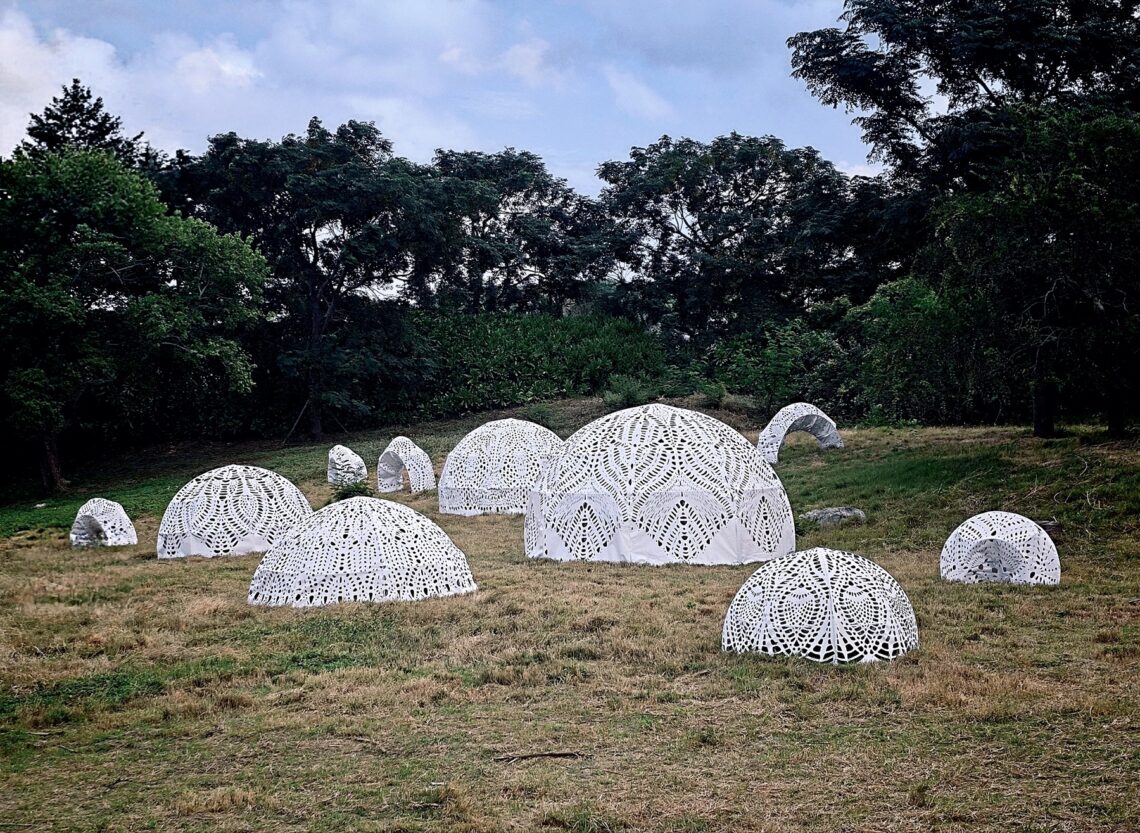
Visual artist Elena Redaelli presents Intertidal Carapaxia – Wetland Future Fossils, a large-scale, site-responsive sculptural installation at Siangshan Wetland Natural Park. The work is part of the 2026 Siangshan Wetland Art Festival, on view from 2 October to 1 November 2026.

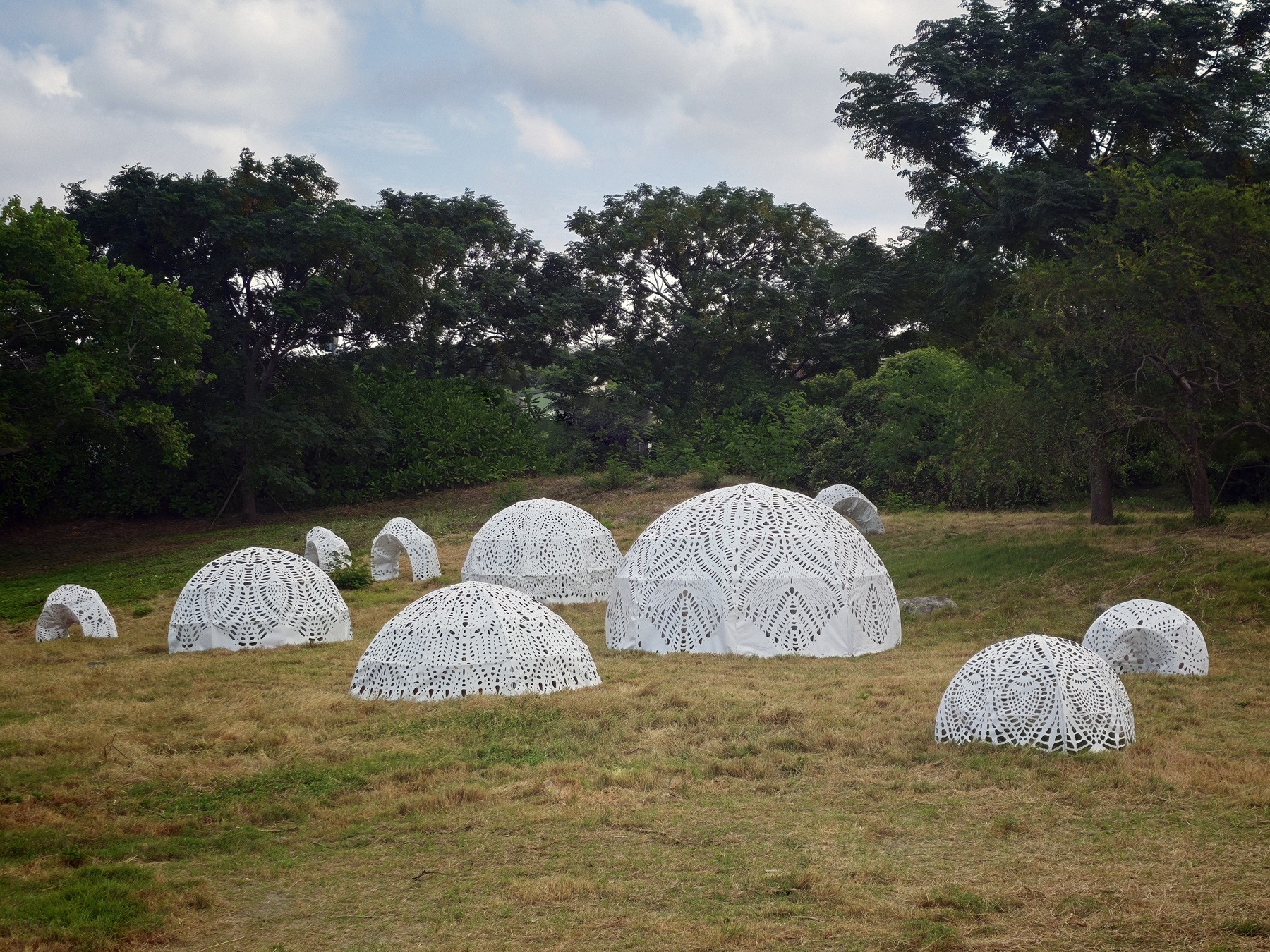
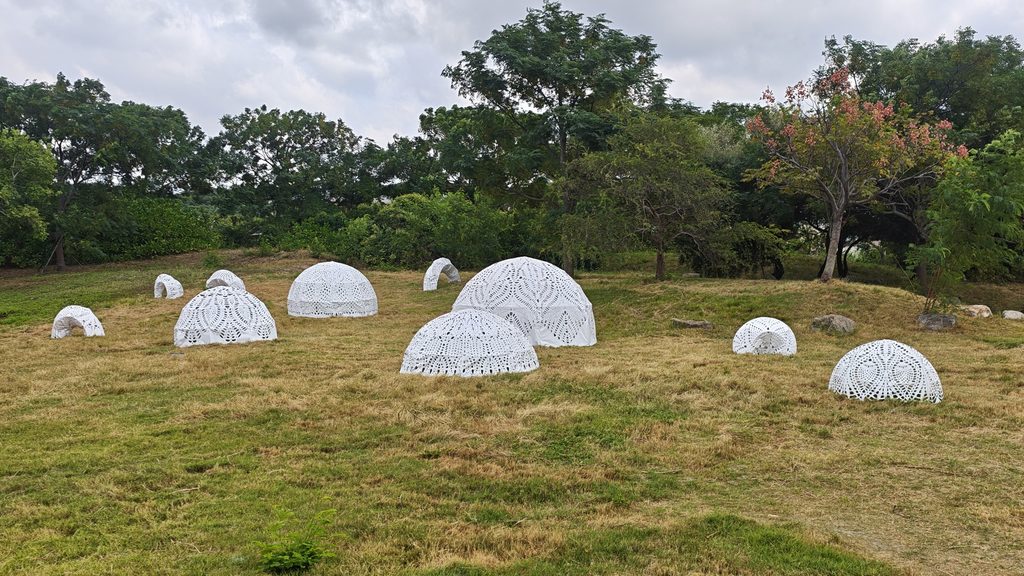
Inspired by Taiwan’s endemic fiddler crab and the microscopic architectures of diatoms, Intertidal Carapaxia takes the form of a mysterious organism emerging from the landscape. Modular metal structures support white membranes cut from discarded advertising banners. Their perforated surfaces recall crochet, translating a familiar textile language into a sculptural body of curved shells and jointed legs.
The installation brings the wetland’s organic forms into contact with materials left behind by human activity. Synthetic banners, designed for temporary messages yet resistant to decomposition, become the skin of an imagined future fossil. Their presence raises a question about what will remain as environmental pressures reshape the coast, and how the materials people discard enter the histories of the places they inhabit.
Redaelli’s interest in Siangshan developed through exploring the surroundings of Hsinchu during her residency at the Art Site of the Railway Warehouse. Her practice brings textile processes into sculptural installations, approaching making as a way of learning from a place. Previous projects in Cheng Long Wetland and Guandu Park have also informed her attention to wetland environments and the relationships between their inhabitants and local materials.
In Intertidal Carapaxia, cutting and assembling a synthetic membrane becomes a human attempt to approach the intricate beauty of living forms. The work invites viewers to look beyond its imagined body towards the organisms that inspired it, and to consider the care needed to sustain the fragile balance of their habitat.

Under the theme “踏走一道波痕 STEP BY STEP,” the 2026 Siangshan Wetland Art Festival brings together eight artists and teams from Taiwan and abroad. Their works respond to the wetland’s landscape and ecology, drawing on local memory to create encounters between art and place.
Intertidal Carapaxia – Wetland Future Fossils, by Elena Redaelli, is presented as part of the 2026 Siangshan Wetland Art Festival – STEP BY STEP, taking place from 2 October to 1 November 2026 at Siangshan Wetland Natural Park (香山濕地自然公園) in Hsinchu City, Taiwan. The installation is located at No. 17, Lane 500, Section 3, Xibin Road, beside the Crab-Watching Trail.
About the artist
Elena Redaelli is an Italian visual artist based between Italy and Taiwan. Working across sculpture and site-specific installation, she explores materials as carriers of lived histories and as active participants in the making process. Her installations develop through close observation of a place, responding to its physical conditions and the cultural practices that shape it.
Material experimentation is central to her work. Using locally sourced, found and reclaimed materials, she investigates how their properties and previous uses can guide their transformation. Textile techniques extend into spatial structures, while the materials’ resistance, fragility and capacity to change influence how each work takes form. Her installations range from ephemeral interventions to structures that remain exposed to weathering over time.

Her participatory practice invites people into the development and production of artworks through workshops and collective making. These encounters create opportunities to exchange practical knowledge and allow participants’ decisions to shape the outcome. Authorship becomes shared through a process in which different skills and experiences remain present in the finished work.
Across gallery and outdoor settings, Redaelli considers how installation can make relationships between people and their surroundings tangible. Her works bring material histories into new spatial arrangements, inviting attention to the ways human activity intersects with the lives and processes of the wider environment.
.


