HOW SLOWLY CAN I WRITE? – FEDERICA PATERA AND ANDREA SBRA PEREGO EXHIBIT AT WEBER & WEBER GALLERY IN TURIN
Weber & Weber Gallery presents How Slowly Can I Write?, an exhibition by artistic duo Federica Patera and Andrea Sbra Perego, curated by Barbara Pavan. The exhibition opens on Tuesday, 27 October 2026, from 6 to 9 pm, at the gallery’s premises at Via San Tommaso 7, Turin, and will remain on view until 16 January 2027, Tuesday through Saturday, from 3:30 to 7:30 pm.
Language and fiber art lie at the heart of the artists’ practice, rooted in the intrinsic connection between literary and textile languages. Fibers also carry a symbolic significance, evoking nomadic cultures and a conception of space that unfolds over time, much like the succession of words in reading and writing or the unfolding of performance art. Their works weave this temporal dimension into the languages of visual art, transforming fabric into a vehicle for a dynamic that transcends the static nature of space. For the two artists, the word is both a concrete and an abstract element, a means of defining and understanding the world while retaining an inevitable – and, one might venture to say, magical – relationship with what cannot be fully expressed.
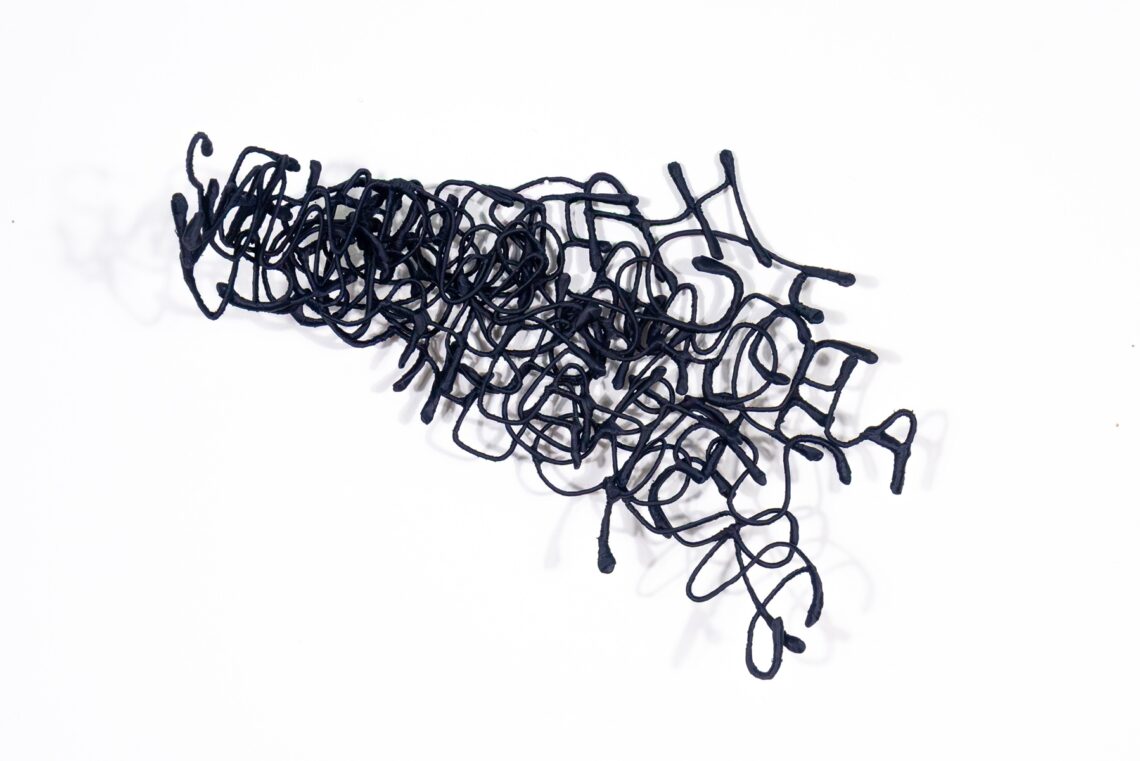
The question that gives the exhibition its title introduces a notion of writing freed from the speed of communication and its immediate function of conveying meaning, restoring centrality to the process through which meaning takes shape. Writing becomes a sequence of steps requiring time and attention, an act of resistance. The word no longer appears at the moment it is conceived or spoken; instead, it undergoes a process through which it must be physically constructed. In the artists’ practice, this process takes shape through thread and fabric. Writing is broken down into the gestures required to make it visible: following a line, wrapping a letter, covering a surface, again and again, until a trace becomes a presence and a practice becomes a form of meditation. “L’esprit fait la main, la main fait l’esprit,” wrote Henri Focillon in Vie des formes. The hand thus introduces a dimension of language that writing usually conceals: the time it takes to come into being. What we normally perceive as an immediate mark on a page is revealed here as the visible result of a slow, painstaking process of construction, of a form of making that actively intervenes in the material reality of the world.
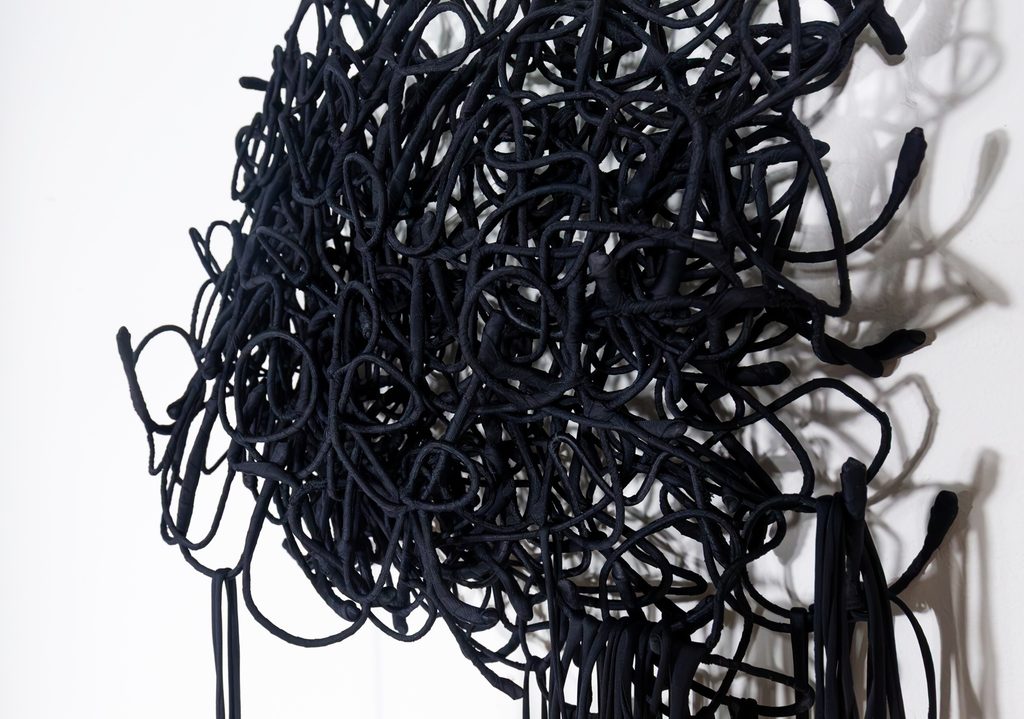
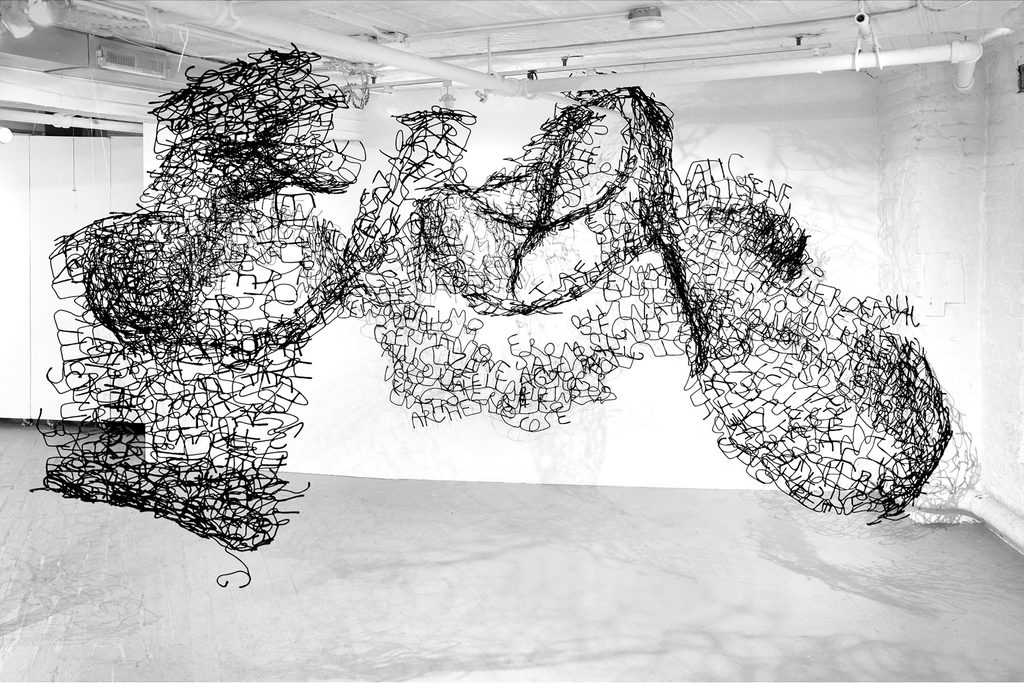
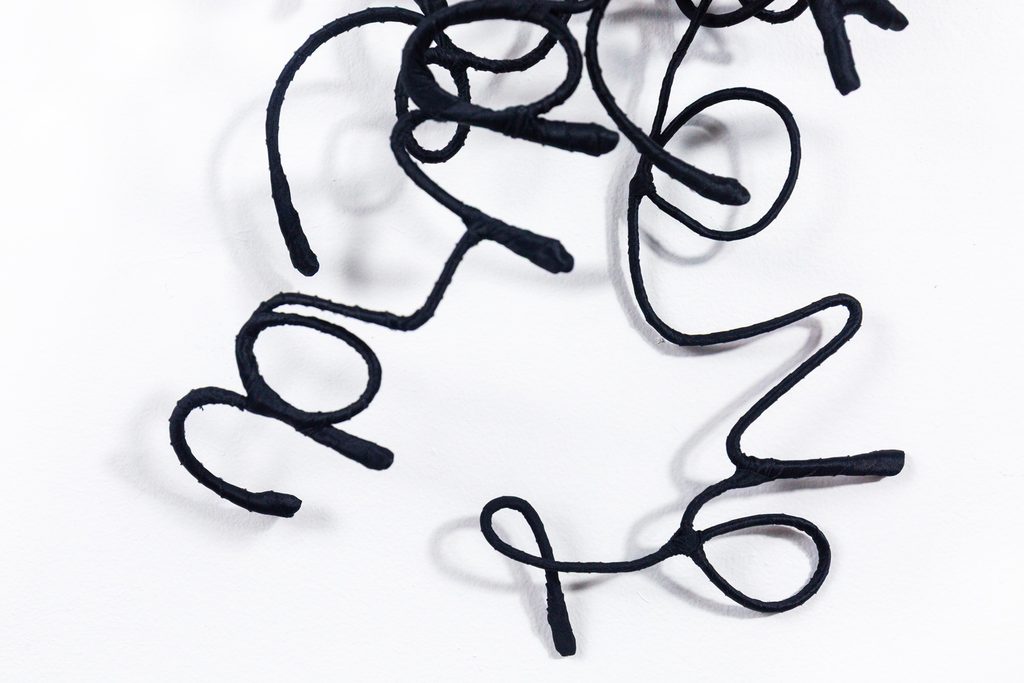
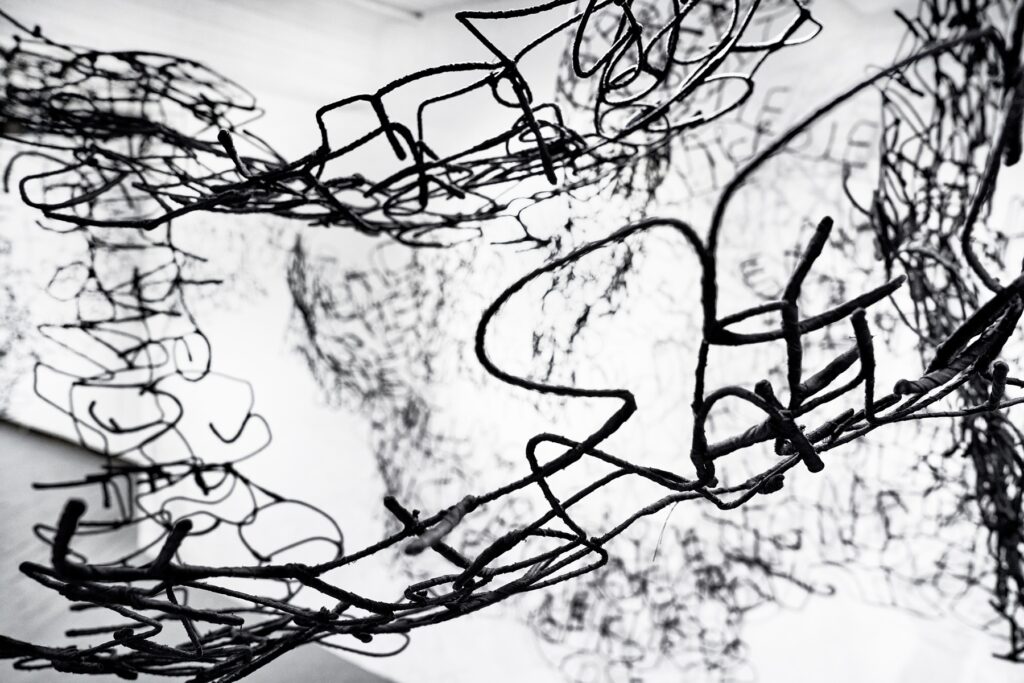
Through this gradual process of construction, the word begins to change its nature. Covered and layered, letters lose their sharply defined contours; the word itself becomes blurred, increasingly difficult to recognize, until it transforms into something else: a surface, a mass, giving rise to a paradox. As writing acquires material substance, language loses some of its legibility, becoming more ethereal and enigmatic. Meaning does not disappear entirely but remains as a possibility, a memory, a trace embedded in form. What meets the eye is therefore something to be observed and experienced perceptually before it can be read. The gradual transformation of the works – from delicate, almost two-dimensional presences into increasingly substantial volumes on the one hand and immersive installations on the other – further accentuates this shift. In recent years, Patera and Sbra Perego’s practice has increasingly embraced three-dimensionality, at times reaching monumental proportions. This expansion into space also entails a broader perspective, transforming the relationship between the work, its surroundings, its materials and the viewer. In the sculptures presented in the exhibition, the word occupies space, gains depth and weight, and becomes an object. It is no longer a strip recalling the linearity of writing on a page, but a body that shares the physical space of its surroundings with the visitor.
The relationship between saying and doing thus acquires a new density. To construct a word is to remove it from abstraction and subject it to the tangible resistance of matter. It can no longer simply be spoken or uttered; it must be sustained by a succession of gestures and physically brought to completion. The artists’ bodies become part of the process that determines the forms and movements of the work, leaving their imprint and almost becoming integral to it. As Focillon also observed, the action of the hand defines both the emptiness of space and the fullness of the things that occupy it. The time required to create the work becomes inseparable from what it asserts. The word acquires a binding force: what is said must also be done, and the act of making renders visible the material commitment and tangible cost of that utterance. Slowness is therefore not merely a feature of the process but one of its essential conditions. It is a deliberate choice that challenges the efficiency conventionally associated with writing and communication. In a present shaped by the ever-increasing speed with which words are produced, transmitted and consumed, Patera and Sbra Perego’s works introduce a different temporality. Writing is deliberately slowed down, made physical and even stripped of its practical function. Time remains embedded in the form of the work, becoming visible through the volume and texture of the pieces and, in the large-scale installation presented in the exhibition, manifesting itself through sound as well.
The sound design by Luca Imperato opens up a second direction of inquiry. Sound extends the field of writing beyond what can be seen, transforming it into something that unfolds and manifests itself through a rhythm that exceeds the individual visitor while drawing them into the experience. Here, too, the individual word seems gradually to lose its autonomy, becoming part of a broader dynamic. The visual mass is matched by a collective, choral vocal dimension. What tends to merge into a unified form on the surface multiplies and layers itself in sound. Language is no longer merely a system of signs but a shared presence. In both complementary movements brought into dialogue by the exhibition, the process never remains concealed behind the final result; it continues to be perceptible within the work itself.
The question posed by the title remains open, probing the very limits of writing and the point at which it changes its nature. How Slowly Can I Write? invites us to consider how we might experience words beyond their linguistic function. A word can lose its clarity without entirely losing its memory; it can cease to be merely something that says and become something that happens.
The exhibition How Slowly Can I Write? will be on view at Weber & Weber – Modern and Contemporary Art, Via San Tommaso 7, Turin, from 28 October 2026 to 16 January 2027, Tuesday through Saturday, from 3:30 to 7:30 pm. The opening reception will take place on Tuesday, 27 October, from 6 to 9 pm. For further information, visit www.galleriaweber.it, email direzione@galleriaweber.it, or call +39 011 19500694.
Federica Patera and Andrea Sbra Perego are an Italian artistic duo based in New York. Since 2017, they have developed a practice at the intersection of literature, writing and visual art. Their work brings together textile art, installation, sculpture and linguistic research, exploring the relationships between language, matter, memory and the construction of reality. Their work has been presented in solo exhibitions at Raffaella De Chirico Arte Contemporanea in Turin, with RAR: 2015–2020 (2020) and Extended Version (2022); Manuel Zoia Gallery in Verona and Milan, with Note senza testo (2021) and The Ongoing Tale (2023); SCD Studio in Perugia, with Tĕxere (2022); and Weber & Weber in Turin, with Flowering Clouds (2024). Notable group exhibitions include the 25WTA – Italian Act (2022–2023), featuring The Soft Revolution at the Textile Museum in Busto Arsizio and Fiberstorming in Bergamo as part of the Bergamo Brescia Italian Capitals of Culture programme; the International Biennial of Contemporary Fiber Art at the Museum of Embroidery and Textile in Valtopina (2024); Threads of Our Time at Chelsea Market in New York (2023); and Follow the Thread, a site-specific installation created for Scavolini SoHo Gallery in New York (2023). They have also exhibited at Ivy Brown Gallery in New York and participated in international art fairs, including ArtVerona, WOP Art Fair in Lugano and UnFair in Milan. In 2024, they were finalists for the Alpine Fellowship Visual Art Prize and the international Arte Alta award, receiving an honourable mention from the jury. That same year, they received the Mothership NYC Residency Award 2025. More recently, they presented The Way Words Turn at Scavolini SoHo Gallery as part of New York Textile Month. Their work is also featured in the group exhibition Women Pulling at the Threads of Social Discourse – The Epistle at THE CAMP Gallery in Miami.