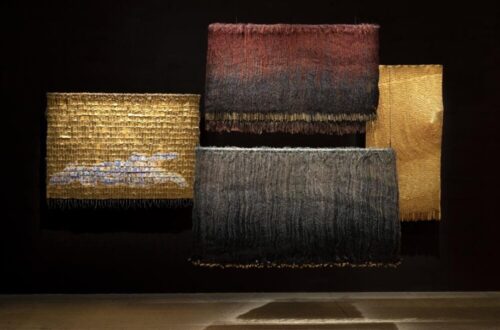

EXTINCTIONS. DEBORAH KRUGER AND THE GEOGRAPHIES OF LOSS AT MUMA, MACCAGNO
There is a particular coherence between Deborah Kruger’s artistic practice and the venue hosting her first solo exhibition in Europe. From July 11 to October 25, 2026, MuMa | Civico Museo Parisi Valle in Maccagno, on Lake Maggiore, presents EXTINCTIONS, a project curated by Barbara Pavan and organized under the patronage of the Municipality of Maccagno con Pino e Veddasca and ProLoco Maccagno.

(detail)
hand screen-printing on recycled plastic, hand and machine sewing
150 x 291 x 2,5 cm | 59 x 114,5 x 1 in
The museum is far more than a mere exhibition venue; it is an integral part of the project itself. The celebrated “bridge-museum” conceived by architect Maurizio Sacripanti at the initiative of sculptor Giuseppe Parisi and now directed by Federico Crimi is an architectural structure that dissolves the traditional separation between building and landscape. Suspended above the Giona stream where it meets Lake Maggiore, the museum transforms natural elements into active components of the visitor’s perceptual experience, providing an ideal setting for an artistic practice centered on the relationships between environment, memory, and culture.
For years, Deborah Kruger has developed a body of work that intertwines ecological concerns with processes of cultural erasure. In EXTINCTIONS, these themes converge in a significant group of recent works addressing two phenomena that appear distinct yet are deeply interconnected: the extinction of numerous bird species and the progressive disappearance of Indigenous languages. For the artist, both processes are manifestations of the same systemic crisis, one that simultaneously affects natural and cultural ecosystems, undermining both the planet’s biodiversity and the plurality of human knowledge.

hand screen-printing on recycled plastic, hand and machine sewing, wrapping, cording, waxed linen thread
295 x 125 x 5 cm | 116 x 49 x 2 in
Ph.credit Carlos Díaz Corona

TARABUSINO BIRD GODDESS – 2026
resin and fiberglass sculpture, pigment, recycled plastic, screen printing, hand and machine stitching, cording, waxed linen thread
71 × 51 × 51 cm | 28 × 20 × 20 in
Edition 1/7, produced by Art21 Studio
Ph. credit Carlos Díaz Corona
The exhibition brings together textile sculptures, monumental tapestries, and wall-based works. Uniting these formally diverse pieces is one of the most distinctive elements of Kruger’s practice: feathers created from remelted recycled plastic, subsequently screen-printed with images of endangered bird species and overprinted with texts in languages at risk of extinction. This material choice is far more than a formal gesture. Plastic – the quintessential symbol of contemporary production and consumption systems and one of the principal drivers of environmental degradation – is transformed into a medium through which the artist exposes human responsibility in processes of ecological destruction and cultural loss.

hand screen-printing on recycled plastic, hand and machine sewing
38 x 38 cm | 15 x 15 in
Ph. credit Carlos Díaz Corona
Kruger’s education at New York’s Fashion Institute of Technology is evident in the central role she assigns to materiality, in the patient construction of surfaces, and in the tactile quality of her works. Textile design, fiber art, and environmental reflection converge in a practice that employs accumulation, layering, and handcraft as tools for examining contemporary economic systems and the consequences of their extractive logics. At the heart of her work lies a relational understanding of existence, according to which organisms, cultures, and languages participate in a complex network of interdependencies that makes it impossible to separate environmental crises from social and cultural ones. Habitat fragmentation and the erosion of marginalized cultures emerge as different manifestations of the same global dynamics, whose consequences are most acutely felt by the most vulnerable entities: threatened animal species and Indigenous communities become sensitive indicators of the fragility of the planetary ecosystem as a whole.

(detail)
hand screen printing on recycled plastic, hand and machine sewing, fiberglass sculpture
434 x 119 x 22 cm | 171 x 47 x 8.5 in
EXTINCTIONS does not merely highlight conditions of loss; it invites viewers to reconsider the relationships between production, consumption, language, and the preservation of life, drawing attention to the individual and collective responsibilities that define the present. For Kruger, art becomes a tool of awareness and transformation, capable of restoring visibility to what is at risk of disappearing and revealing the often-invisible connections linking seemingly distant phenomena.
This perspective is further strengthened by the collaboration with the Fondazione Bolle di Magadino, a Swiss institution dedicated to the protection of the nature reserve of the same name, safeguarded since 1974. Thanks to the Foundation’s scientific support, the exhibition includes a work devoted to the Little Bittern, a threatened bird species inhabiting the Lake Maggiore region. The partnership introduces a particularly significant territorial and cross-border dimension: the ecological issues addressed by the artist transcend administrative boundaries, becoming part of a network of relationships connecting habitats, species, and communities. The Foundation brings together the Swiss Confederation, the Canton of Ticino, Pro Natura, and WWF Switzerland, and works to preserve the biodiversity of the Bolle di Magadino wetlands, a site of international importance recognized under the Ramsar Convention since 1982.

Active for decades within the international fiber art scene, Deborah Kruger has exhibited in museums, galleries, and universities across the United States, Mexico, Europe, Asia, and Australia. Recent exhibitions include Interpretations at the Visions Museum of Textile Art in San Diego (2025–2026); Drifts and Tremors at Aqua Art Fair during Miami Art Week; Drags and Woops: The Poetics of Rupture at MIA Curatorial Projects in Miami (2025), both curated by Milagros Bello; Our Fragile Moment at Hudson Guild Gallery in New York; the Coined in the South Biennial at the Mint Museum in Charlotte; the III Bienal de Artes Plásticas y Visuales de Engativá in Bogotá; the X International Biennial of Contemporary Textile Art in Miami; the Rufino Tamayo Biennial in Mexico City; and Fiberart International in Pittsburgh. Her work is held in permanent collections including the Museum of Arts and Design (MAD) in New York, the Visions Museum of Textile Art in San Diego, the City of Raleigh, and the World Textile Association. A large-scale wall installation by the artist is currently on view at the United States Embassy in Turkmenistan as part of the Art in Embassies Program. In 2024, she presented the solo exhibition Turbulence: Birds, Beauty, Language & Loss at the Block Gallery in Raleigh, and throughout her career she has participated in residencies at the Millay Colony for the Arts, La Porte Peinte Centre in France, Hypatia-in-the-Woods, and the Icelandic Textile Center.
The exhibition is accompanied by a trilingual catalogue in Italian, English, and German, published by Al3vie Editore.