
STITCHING TIME BACK TOGETHER: FRAGMENTS OF LIFE IN THE WORK OF FANNY ALLIÉ
| by Raffaella Polverini |
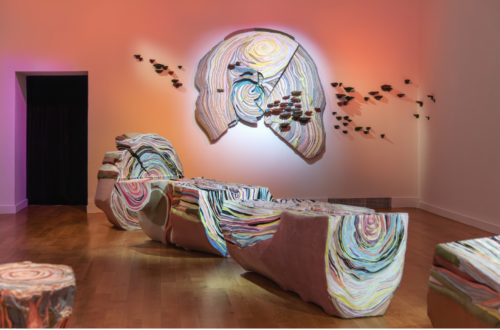
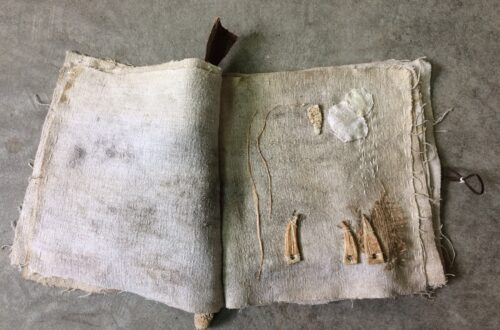
Fanny Allié, born in Montpellier, France, earned a Master’s degree from the École Nationale Supérieure de la Photographie before settling in New York City. Her artistic practice combines mixed media and textile-based languages, emerging from an exploration of discarded materials, lost objects, and the marginal elements of everyday life. This perspective enables an investigation into human experience and the fragile, interconnected narratives that shape the fabric of social existence.
The artist’s practice may therefore be understood as that of a contemporary gatherer of discarded materials – both her own and those of others – through which she investigates the relationship between abandoned objects and the bodies that once used them. Her work reveals a sustained attention to the connection between individuals and their environment, beginning with what has been cast aside, with particular emphasis on the environmental and socio-cultural implications of throwaway culture.

Through processes that reactivate the human traces embedded within these materials, they are reworked as testimonies to impermanence, memory, transition, and loss.
These layered compositions emerge from experiences that are both individual and collective, forming shared
symbolic constellations deeply rooted in the contemporary urban context. The artist repurposes discarded materials and objects to construct figures and presences that retain traces of their original environment, drawing from both the urban landscape and references to dance and theater. The resulting psychological and emotional landscapes explore the spaces of everyday experience, beginning with the body, understood as the primary site of experience, perception, and the subject’s inscription within the world.
In dialogue with her studio practice, grounded in manual processes, the artist develops site-specific public art interventions and participatory projects focused on investigating forms of social interconnectedness, collective experience, and modes of relating to the spaces of contemporary living. Her research examines the relationships individuals establish with spaces of dwelling, work, and transit, with the aim of activating practices of belonging, responsibility, and care toward both the environmental and social context. (…)
FULL ARTICLE IS INCLUDED IN ATLAS – CHAPTER ONE, AVAILABLE FOR PURCHASE AT WWW.AL3VIEATC.COM/SHOP/ATLAS-CAPITOLO-UNO/ OR BY CLICKING ON THE COVER