
CARTOGRAPHIES OF MEMORY: TIME, SPACE, AND IDENTITY IN THE ART OF NAOMI MIDDELMANN
| by Barbara Pavan |
Born in Switzerland, Naomi Middelmann moved to New York at the age of sixteen, where she completed her education with a degree in Creative Writing and International Relations from Johns Hopkins University. After working in the publishing sector, she returned to Europe to pursue visual arts, earning a postgraduate diploma from the Visual Art School in Basel in 2009. Her work has been presented in over seventy solo and group exhibitions in museums, galleries, and art fairs across Europe, Australia, Canada, and the United States.

Middelmann’s artistic research is grounded in a critical reflection on the unstable and processual nature of time and space: just as it is impossible to return to the same place or the same moment, both reveal themselves as entities in constant transformation. This awareness constitutes the conceptual core of a practice that investigates, with both rigor and poetic sensitivity, the intersections between memory, geography, and migration. Her work unfolds within a dialectic between interruption and the experience of encounter, framing place-making – the transformation of “space” into “place” through a network of relations, memories, practices, and subjective perceptions that confer meaning, identity, and value – and remembrance as open-ended, dynamic, and inherently unfinished processes. Time and place thus cease to function as fixed coordinates and instead emerge as living, layered presences that are continuously redefined through experience.
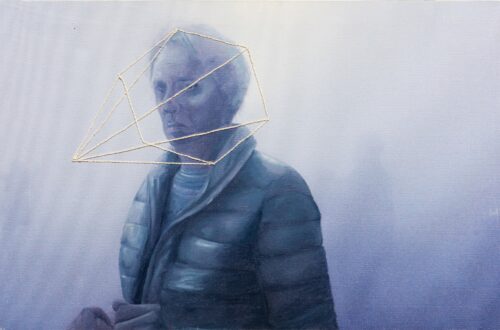
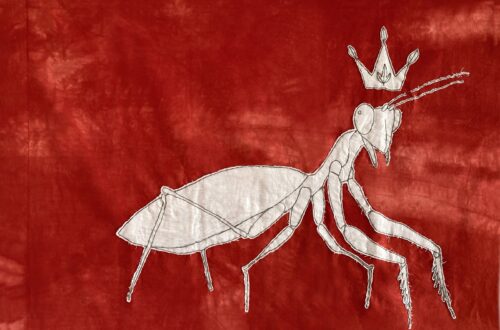
Through an interdisciplinary approach that includes the reworking of found objects, large-scale textile installations, drawing, and painting, the artist explores the mechanisms of memory, highlighting its subjective and constructive dimensions as well as its implications for the formation of identity. Her artistic practice can therefore be understood as a space of negotiation and construction, where heterogeneous fragments—material, temporal, and symbolic – intertwine, generating new modes of perception and belonging.

Naomi Middelmann has developed an extensive and international exhibition trajectory, including numerous shows across Europe and the United States. Among her most recent museum exhibitions are those at the Museo San Domenico in Trapani, the Museo del Fiume in Nazzano, the Museo della Zisa in Palermo, and Le MAF in Switzerland, alongside earlier presentations at venues such as the Westbeth Art Center in New York, the Corvallis Art Center in Oregon, and the Torrance Art Museum in California, as well as European institutions including the Dreiländer Museum in Germany and Kunstraum Hochdorf. In addition to institutional participations, the artist has realized several solo exhibitions, most recently at Galerie 10 in Lausanne in 2026, Gallery Jasmin Glaab in Bern in 2025, and Postcollapse Art Space in Zurich in 2023. Her exhibition activity is further marked by a significant presence in international group shows, including recent participations at Woman Made Gallery in Chicago and the “Sonder” project at Le Cabanon in Lausanne in 2026, as well as initiatives such as Fresh Legs and Scout at Gallery Heike & Arndt between Berlin and Kettinge in Denmark, and her participation at the Westbeth Art Center in New York in 2024.
This is what she told us about her work and professional journey.

Your artistic research consistently engages with themes such as memory, identity, and the instability of perception. How did these concerns first emerge in your practice, and how have they evolved over time?
This interest began to take shape about a decade ago, shortly after I completed art school. My first bachelor’s degree was in International Relations, where questions of migration, geopolitics, and identity first emerged for me in a theoretical framework. At the same time, they were deeply personal: I hold three passports and have lived in sixteen different places, so issues of belonging, displacement, and cultural translation were not abstract concepts but lived realities. In my early work, this often translated into an exploration of fragmented narratives and hybrid forms, reflecting the layered and sometimes contradictory nature of identity itself.

The themes of memory and the instability of perception developed a few years later, around seven or eight years ago. They were catalyzed in part by reading writers such as neurologist Oliver Sacks and the writer Siri Hustvedt, whose work reveals how fragile and constructed our sense of reality can be. Their reflections on neurological cases and subjective experience opened up a new way of thinking about memory for me – not as an archive that we makes us who we are, but as something dynamic, fallible, and continually rewritten. This line of inquiry deepened during an artist residency in a neuroscience laboratory, where I encountered scientific methodologies for studying memory and perception firsthand. Being immersed in that environment allowed me to observe how empirical research approaches phenomena that are also profoundly intimate and subjective.

Over time, my practice shifted from focusing primarily on autobiographical material – my own memories and identity questions – toward broader investigations. I became increasingly interested in the tension between subjective experience and scientific representation, and in how the brain actively constructs, edits, and even manipulates what we perceive as reality. Today, these themes function as personal motifs and as conceptual frameworks through which I examine memory and the unstable ground on which perception is built using a variety of media. My artistic process tries to emulate these issues.
In some of your works, you explore what you describe as a “cartography of memory,” transforming personal recollections and experiences into layered visual landscapes. How does the process unfold through which a subjective experience or memory is translated into a spatial or cartographic form?
Cartography of Memory, as a series, grew out of an artist residency at the Musée Jenisch in Vevey, Switzerland in 2021. Following six months spent working in a neuroscience laboratory, I wanted to question how I experienced memory on a personal level. I created a self-imposed experiment. I dedicated an entire week – forty-two consecutive hours – to drawing my memories onto a 25-square-meter surface. The process was deliberately durational and immersive, allowing memory to unfold in real time rather than being selectively edited or retrospectively organized.

sewing on found map 2024
What quickly became apparent was how little we actually remember visually with clarity and how mutlisensory our memories actually are. I imposed one strict rule: I would not consult any external references – no maps, photographs, or architectural plans. Everything had to be drawn from memory alone. As a result, the work resists the conventions of cartography. There is no stable scale, no fixed orientation, and no linear chronology, as one would expect from a traditional map. Instead, memories surface and fade unpredictably. They connect across time and space in associative ways, forming clusters, gaps, and overlaps.
The piece operates partly as a mapping – tracing relationships between places, events, and temporal layers – but it is equally shaped by imagination. Neuroscientific research suggests that the boundary between remembering and imagining is almost imperceptible; both processes activate overlapping neural networks. What interested me was not illustrating that theory, but experiencing it firsthand. I wanted to inhabit that fragile threshold where recollection begins to blur into invention, where the act of remembering becomes inseparable from the act of creating.
This work has then developed over the years, where now I play with mapping and creating imaginary and real cities, spaces and interactions.
Fragile and lightweight materials – such as gauze, paper, or reclaimed textiles – frequently appear in your work. What symbolic or conceptual value do you attribute to these delicate surfaces, particularly in relation to themes of memory, loss, and transformation?
I am drawn to working with gauze and other fragile materials – such as found maps or reclaimed textiles – because the material qualities themselves already carry meaning. Their delicacy, permeability, and vulnerability resonate strongly with the themes I explore. Memory, after all, is not solid or fixed; it is porous, easily altered, and susceptible to erosion. Gauze, for example, is translucent and layered – it reveals and conceals at the same time – much like the way memories partially surface while other parts remain obscured.
Found maps also interest me because they embody an attempt to stabilize and define space, yet they become unstable as geography is always evolving. Their authority dissolves. In that sense, the material reflects how context shapes both memory and perception: what we recall and how we interpret it are always influenced by where we stand and what framework surrounds us.

These lightweight materials also carry a sense of temporality and transformation. They can tear, fold, stain, and age; they register touch and time. Rather than resisting that vulnerability, I embrace it as part of the work. The fragility of the surface becomes a metaphor for fragility, but also for change – suggesting that memory is not something we preserve intact, but something that continually shifts, changes, and creates.
In several projects, you use atlases, historical maps, and archival materials that are cut, layered, and reassembled. How does this reworking allow you to question conventional notions of geography, history, and objectivity?
Landmarking and mapping are profoundly human endeavors. They reflect our desire to orient ourselves, to define territory, to establish borders and fix meaning. And yet the terrain itself – geological formations, coastlines, political boundaries – is constantly shifting. Maps present themselves as scientific and objective documents, but they attempt to capture something that is inherently unstable and in flux.
At the same time, maps are deeply poetic objects. They evoke places we may never visit, suggesting routes, connections, and imagined possibilities. They hold aspirations and projections as much as data. Yet they also reduce a complex, three-dimensional, lived world into a flat, two-dimensional representation. In doing so, they inevitably simplify, omit, and impose structure.

By cutting, layering, and reassembling atlases and archival maps, I engage directly with these contradictions. The act of fragmentation disrupts the illusion of objectivity; it exposes the constructed nature of geography and history. When I reconfigure these materials, borders shift, hierarchies dissolve, and new relationships emerge. The gesture becomes both critical and generative. At the same time, this process allows me to reintroduce a kind of organic, spatial presence to the map, such as through sewing on found maps, which I have been doing more recently. Through layering and physical manipulation, the surface regains depth and materiality. It becomes less of a detached, authoritative image and more of a living, tactile object—one that acknowledges its own subjectivity and the instability of the world it seeks to describe. I like that materiality takes over the scientific endeavor of trying to tie down facts and fitures.
In your artistic practice, what relationship do you see between writing, reading, personal experience, and visual language? How do these elements interact in shaping the meaning of your work?
Reading and writing are foundational to my practice, even though my primary language is visual. I read widely – neuroscience, philosophy, socialogy, anthropology, political science, poetry, literature – and these fields continually shape the conceptual framework of my work. They offer different ways of thinking about perception, memory, subjectivity, and power. This intellectual engagement feeds the visual process, not as illustration, but as a kind of underlying structure or tension.
Besides International relations courses, I also studied creative writing in college because I wanted to become a writer. However, I quickly felt frustrated by the immaterial nature of writing – the fact that language, on the page, lacked the tactile and spatial dimension I was drawn to. What I eventually realized is that I wanted to translate language into a material experience. That early desire to write never disappeared; it simply transformed and became embedded within my visual language.

In works such as Qui se souviendra de moi, I found a box of letters written by a French woman living in Indochina between 1920 and 1929. Each week, she wrote home to her children. Encountering this archive was deeply moving: the letters carry intimacy, distance, longing, and the weight of history. By using her correspondence as the basis for a series, I was interested in allowing language to function on multiple levels. The words generate meaning, of course, but they also become physical matter—ink, paper, texture, trace. They are not only read; they are handled, layered, fragmented, and recontextualized.
In this way, personal experience, reading, and visual form constantly interact. Text becomes image, image becomes narrative, and meaning emerges in the space between what is said, what is remembered, and what is materially present.
Your biography unfolds across different cultural contexts, between Europe and the United States. How has this transnational dimension influenced your sensitivity to themes such as place, belonging, and displacement?
Growing up and living between Europe and the United States has profoundly shaped my sensitivity to questions of place and belonging. Moving across cultural contexts makes you acutely aware of how identity is relational – how it shifts depending on language, geography, and social codes. You become both insider and outsider at once. That in-between position has made me attentive to nuances: accents, gestures, unspoken norms, and the subtle ways in which history inhabits a place.
The transnational dimension of my biography has also made displacement feel less like an exception and more like a condition. Belonging is never entirely fixed; it is negotiated, layered, and sometimes fragile. I am interested in how places are internalized—how they become part of memory and imagination even after we leave them. In that sense, “place” is not only geographic, but remains an open ended question.
Living between contexts has also heightened my awareness of borders – not only political ones, but cultural and perceptual borders. Each country carries its own narratives, myths, and historical frameworks. Navigating between them reveals how constructed these narratives are, and how differently reality can be framed. This experience feeds directly into my practice: it encourages me to question fixed perspectives and to explore the instability of maps, memories, and identities.
Ultimately, the transnational nature of my life has made me comfortable with ambiguity. Rather than seeking a singular point of origin, my work often inhabits the space of overlap – where languages, histories, and personal geographies intersect and sometimes contradict one another.
In many of your installations, viewers move through layers of materials and visual traces. What role do you assign to the audience in activating or constructing the meaning of the work?
The viewer is not a passive observer in my installations; they are an active participant. Because many of the works are layered – physically and conceptually – the act of moving through them or around them becomes part of the experience. As the body shifts position, certain elements are revealed while others are obscured. Meaning is therefore not fixed; it unfolds through proximity, perspective, and duration. The fragility of the material works with this idea too. The gauze is so light that the act of walking past it will make it move or breathe, as though the work responds directly to the person looking at it.
I think of the viewer as someone who completes the work. The fragments, traces, and materials I present are intentionally open-ended. They do not dictate a single narrative but invite association. Each person brings their own memories, cultural background, and perceptual habits into the space. In that sense, the installation becomes a site of encounter between my investigation and the viewer’s inner archive. The instability I explore – of memory, of perception – is mirrored in the way the work resists a singular, authoritative reading.
Is there a political dimension in your work – understood in the broadest and deepest sense of the term – particularly in relation to identity, migration, and the concept of homeland or home?
Yes, although it is rarely overt or declarative. For me the artist is there to ask questions and not provide answers. The political dimension of my work operates in a subtle but structural way. Questions of identity, migration, and belonging are inherently political because they are shaped by borders, policies, histories, and systems of power. Even the concept of “home” is not neutral – it is entangled with citizenship, exclusion, memory, and narrative.
Rather than addressing these themes through direct commentary, I approach them through material and spatial strategies. By fragmenting maps, destabilizing borders, or layering personal and collective histories, I aim to reveal how constructed and contingent these frameworks are. The instability I explore in perception and memory also has political implications: it challenges the idea of fixed truths or singular histories.
For me, the political lies in creating spaces where complexity can exist – where identities are multiple, where belonging is fluid, and where viewers are invited to question the structures that shape how we perceive ourselves in the world.