FLESH, MEMORY AND REGENERATION: TAMARA KOSTIANOVSKY’S TENTACULAR THINKING
| by Erika Lacava |
There is something about dead bodies that exerts a certain fascination, making it impossible to look away. An inquisitive gaze that asks where the boundary lies, what is concealed in that instant separating the before – life – from the after. Tamara Kostianovsky captures that moment in a timeless bubble, reiterating it endlessly; she moves in and out of the margins, suspending time and blurring its boundaries.
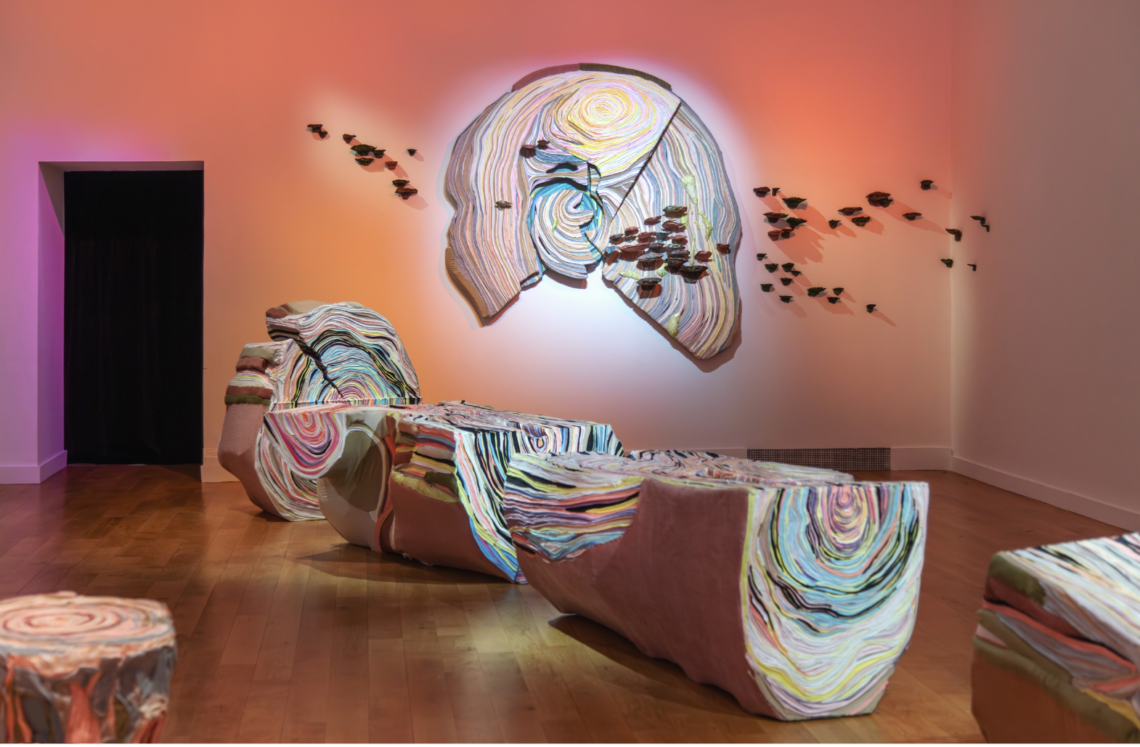
Tamara Kostianovsky’s practice unfolds around the relationship between life and death, stasis and transformation, violence and regeneration. Her textile installations, made from both recycled and secondhand clothing and upholstery fabrics, generate a visual and conceptual short circuit that leaves no on unmoved.
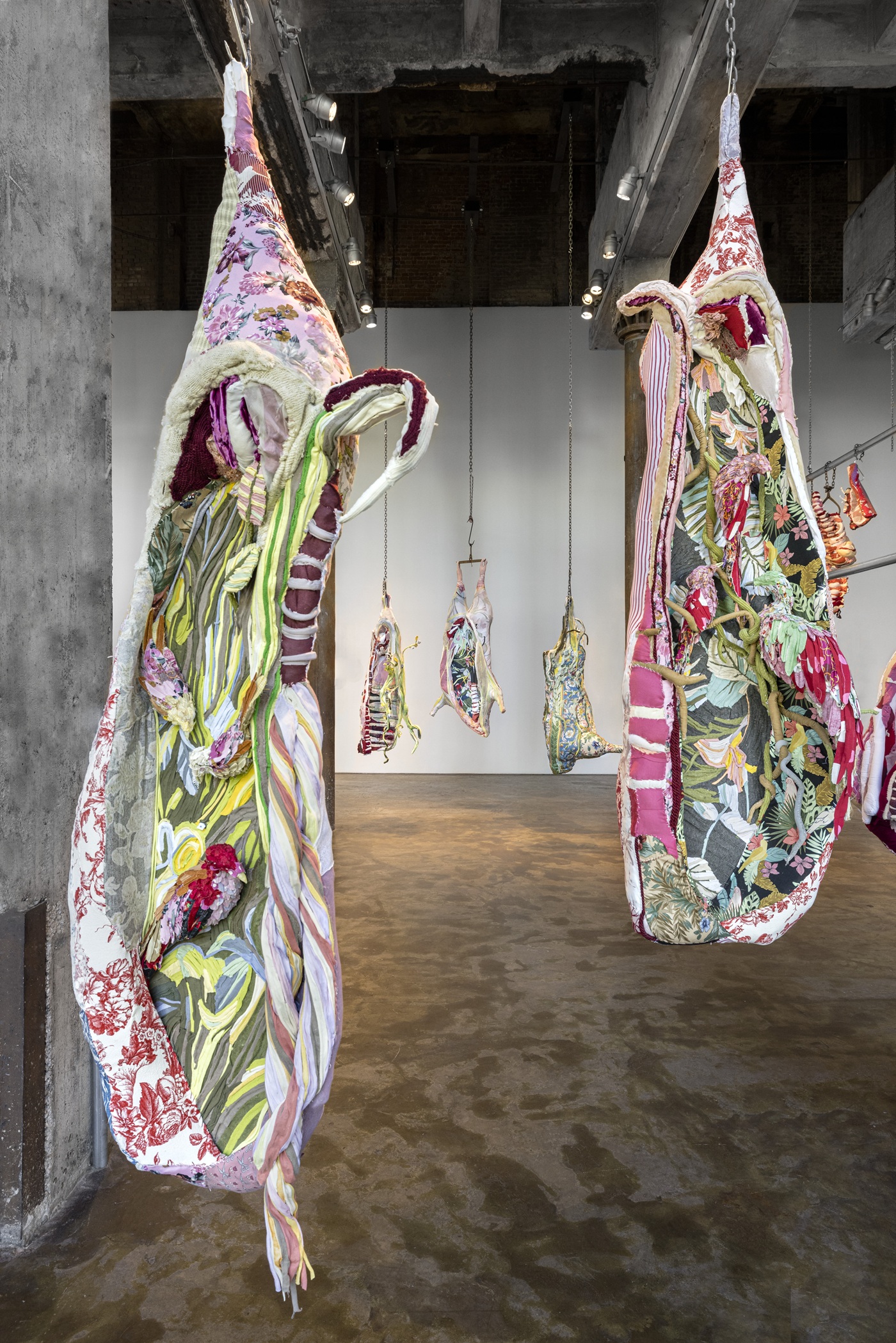
Fabric – an everyday, domestic material, soft and reassuring – takes on the disconcerting appearance of butchered animal carcasses from which flowers emerge; felled tree trunks that reveal within them an infinite, multicoloured network; taxidermied birds suspended amid lush vegetation. The ambiguity that characterises Tamara Kostianovsky’s work, particularly her more recent production, is both its strength and the source of its persistent questioning. It produces a sense of fatal attraction that, at first glance, prevents us from choosing between disgust and wonder, from deciding whether to lean towards anger or forgiveness. Kostianovsky’s work evokes conflicting emotions – fear, anguish, enchantment. It is Freud’s aesthetic category of the uncanny: that which resists representation because it hurts, that which has been repressed because it is too painful or disturbing.
The double with which we have not yet finished reckoning; the unresolved that keeps returning. Tamara Kostianovsky’s work cannot be separated from her biographical experience. Born in 1974, the artist grew up in Buenos Aires during the years of Argentina’s military dictatorship – an overwhelming past, impossible to forget, with its 30,000 bodies disappeared within the span of a few years. A violence that, for a long time, could not be expressed, and whose voice only found a way to become flesh for the artist after her move to the United States. There, she found the most natural way to scream: in the form of quarters of beef hanging from the trucks that travel Argentina’s roads. Social and political violence is thus entwined with ecological violence – the overexploitation of Argentine cattle for meat export, the felling of trees, and the deforestation driven by this trade. For the artist, representing dismembered flesh through fabric is a subtle way of exposing the architecture of violence, giving visible form to the collective trauma of an entire people.
FULL ARTICLE IS INCLUDED IN ATLAS – CHAPTER OTW, AVAILABLE FOR PURCHASE AT WWW.AL3VIEATC.COM/SHOP/ATLAS-CAPITOLO-TWO/ OR BY CLICKING ON THE COVER