SCULPTING THE SHADOWS IN DIALOGUE WITH LUCIA BUBILDA NANNI
| by Giovanni Gardini |
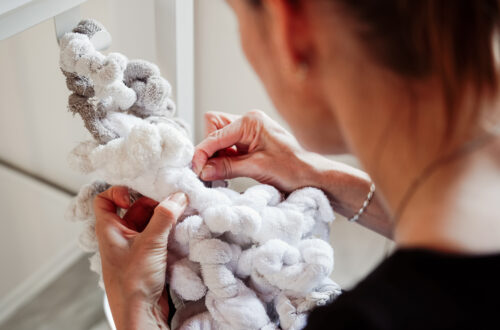
I meet Lucia Bubilda Nanni, an artist from Ravenna, in her studio/workshop/home. I do not think it is possible to fully understand her work without experiencing this space, so saturated with memories. Shrouded in semi-darkness, with the only window kept firmly shuttered even during the day, it feels like a place where the city’s sense of time – with its traffic, rhythms and frenzy – seems to disappear completely. In this kind of dreamlike emporium, overflowing with fabrics, thread and pins, her works are stored in rigorously haphazard order, from her sculptural garments to those made on tulle or hemp, her fabrics of choice.
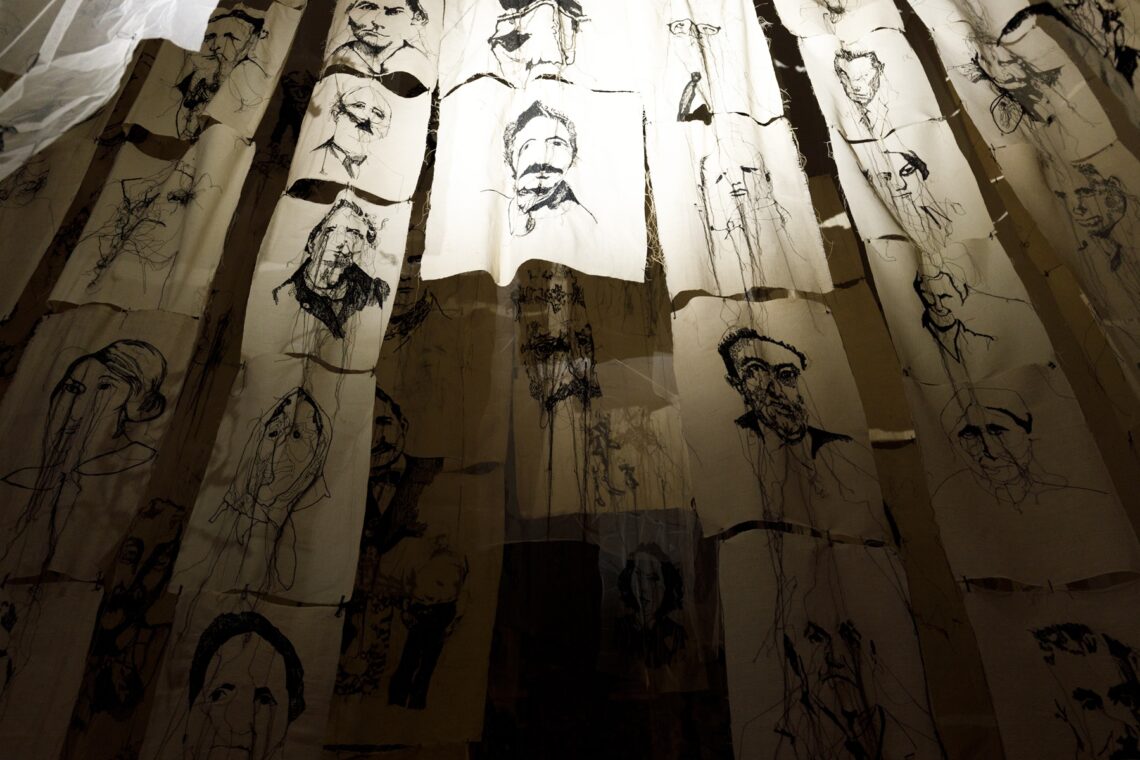
Presiding over everything, although tucked away in a corner, is the sewing machine – “It’s a mechanical machine with an electric pedal,” the artist specifies – which, beneath her restless and tenacious hands, creates faces and landscapes, captures the gazes and poses of humans and animals, and conjures up imaginary insects. Her work is, above all, mental, and it never passes through preparatory drawings, sketches, or any kind of basting. Lucia Bubilda Nanni works directly onto the fabric, passing it through the sewing machine again and again, until needle and thread have left their imprint: recording visions, defining contours and spaces, or creating voids through a process of subtraction.
It is then the light, as it caresses her works, that conjures up phantasmagorical shadows – at times so sharply defined that they appear as a kind of double of the work itself; at others, so fragile and elusive that they seem barely whispered.
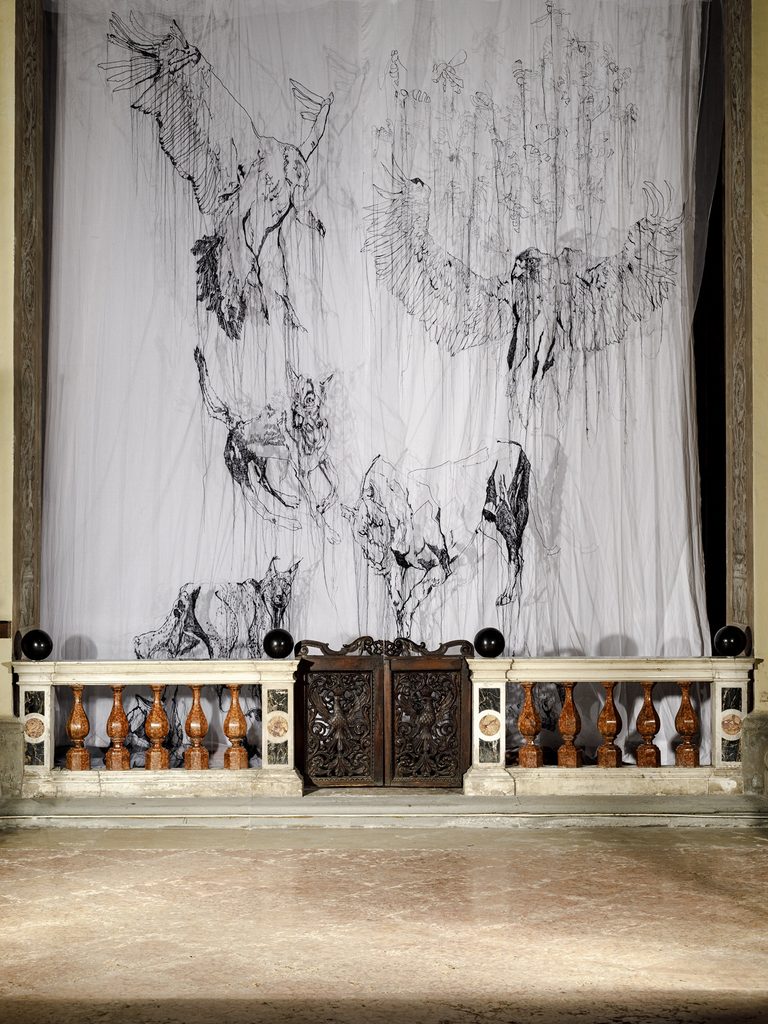
Photo credit Marco Parollo
Looking at your works, especially those made on tulle, shadow emerges as an integral part of your entire artistic practice. Tulle, moreover, is a fabric made of interwoven threads which, as they receive your work, give rise to a double and inseparable weave, in which shadows take on an even more significant role. Thinking of projects such as “Lacrime” or “Cantico”, one might almost say that the shadows are the “real” work.
All my artistic projects are philosophical inquiries – into the history of ideas, of forms, and of shadow. As a student, I would have liked to write a treatise on shadows; now I try to create them, to make them appear. This is why my research turns to physiognomy and to history, in order to bring shadows back and give form to what is no longer there. It is a melancholy and joyful kind of research at the same time: I have the sadism of children who burn an ant with a magnifying glass, and the sudden tears of an impending tragedy.
FULL ARTICLE IS INCLUDED IN ATLAS – CHAPTER TWO, AVAILABLE FOR PURCHASE AT WWW.AL3VIEATC.COM/SHOP/ATLAS-CHAPTER TWO/ OR BY CLICKING ON THE COVER

…