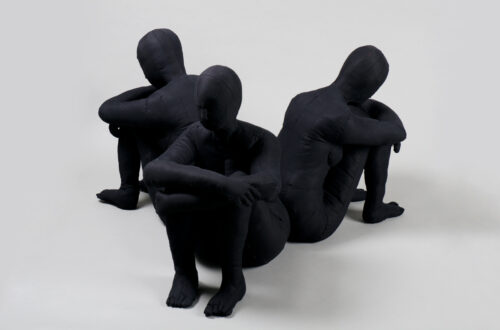

VISIBLE AND INVISIBLE THREADS IN THE ART OF CLAUDIA CASARINO
| by Barbara Pavan |
Claudia Casarino, born in Paraguay in 1974, trained in visual arts at the Universidad Nacional de Asunción and later extended her studies and research in New York and London. Her artistic practice is grounded in an acute awareness of the body, the dynamics of gendered discrimination, and a broader inquiry into the condition of women, often constrained between systemic violence and the pervasive weight of deeply rooted cultural stereotypes.

Recognized as one of the most significant South American artists of her generation, Casarino has exhibited consistently since 1998 in leading international venues, including the Bienal do Mercosul, the Biennale dell’Avana, the Biennale di Tijuana, the Busan Biennale, the Bienal de Cuenca, the Bienal de Curitiba, the Biennale di Algeria, and the Biennale di Venezia, as well as the Trienal de Chile and the Trienal Poligráfica de San Juan. Among her most notable exhibitions is a solo show at the Centro Atlántico de Arte Moderno in Las Palmas de Gran Canaria, curated by Gabriela Salgado. In 2002, she was invited by Cristiana Colli to participate in a group exhibition at the MAN Museo d’Arte Provincia di Nuoro, then under Colli’s directorship, marking her first transatlantic journey. Casarino has also contributed to numerous exhibitions in galleries, museums, and cultural centers across cities such as Asunción, Santiago, São Paulo, Buenos Aires, Bogotá, Madrid, Barcelona, Milan, Amman, and London.

Her engagement with art did not arise from a sudden decision but emerged organically through a gradual process of formation and self-awareness. In 1996, she enrolled in Paraguay’s newly founded art school, integrated within the academic system of the Universidad Nacional de Asunción, initially focused on art history. Over time, this orientation evolved into an autonomous practice, a sustained critical inquiry into the intersections of body, memory, and social structures.

Within her oeuvre, diverse forms of women’s dress frequently serve as recurring compositional modules. For Casarino, whose work interrogates the complex interweaving of bodies and histories, clothing functions as a potent expressive medium. Women’s bodies have historically borne the weight of ideologies, social norms, and political constructs; the history of female garments bears witness to this entanglement of identity, control, and representation. In this framework, garments – while concealing the body – paradoxically reveal more than they obscure, acting as sensitive surfaces that register cultural, social, and political tensions.


The recurring use of tulle reflects both technical and conceptual considerations. Often employed in garments associated with rites of passage in Paraguay and other predominantly Catholic societies, the fabric acquires in Casarino’s practice a charged symbolic resonance. Its transparency evokes the invisibility that frequently characterizes the social and personal issues she addresses. Feminist concerns consistently permeate her work, manifesting across multiple projects. Rather than focusing on a single object, these themes recur cyclically, informed by familial memory, personal experience, and contemporary events.

Over time, Casarino has also engaged with broader socio-environmental issues such as ecological degradation, terricide, and the pandemic. Her approach situates these concerns within a wider feminist framework, critically examining the interrelations between bodies, territories, and systems of power.
Her Paraguayan heritage exerts a formative influence on both her artistic trajectory and visual imagination. Her work integrates the historical weight of colonialism and its legacies, patriarchal structures, and pervasive social power dynamics, alongside multiple forms of violence. Simultaneously, it draws on essential elements of local culture, including the Guaraní language and its distinctive worldview, traditional textiles, and the Paraguayan landscape.

Autobiography is a central element in Casarino’s practice. Many works articulate not only her personal experience but also those of her mother, grandmother, great-grandmother, and numerous other women in her family, particularly on the maternal line. As the artist emphasizes, these narratives transcend individual genealogy, resonating as shared stories among women across the global South.


Reflecting on the role of art in contemporary society – particularly in light of recent global events—Casarino positions her practice as a means to illuminate the unseen and overlooked aspects of everyday life. Conscious of her relative privilege, she nevertheless carries the histories of generations of women who preceded her, women who lacked access to education and well-being. She considers herself in a sense indebted to them. What has long remained unspeakable, silenced, or erased from public discourse resurfaces in her work through suspended garments: delicate yet eloquent presences that restore visibility and voice to memories that have too long remained invisible.