BETTY SALLUCE. CARTOGRAPHY OF RELATION
| by Sabino Maria Frassà |
Every artist inherits a form of memory. For some, it takes the shape of a technique; for others, of a place, a language, or a tradition. For Betty Salluce (an artist born in Matera in 1992), memory is never simply an archive of the past, but rather a process of sedimentation: the way experiences, images, gestures, and landscapes continue to work within us over time, until they find a shared form. It is within this slow transformation that the thread emerges as a defining element of her practice. Not as a decorative choice, nor as the revival of a craft tradition, but as a point of convergence between a biography, an artistic education, and a particular understanding of relation.
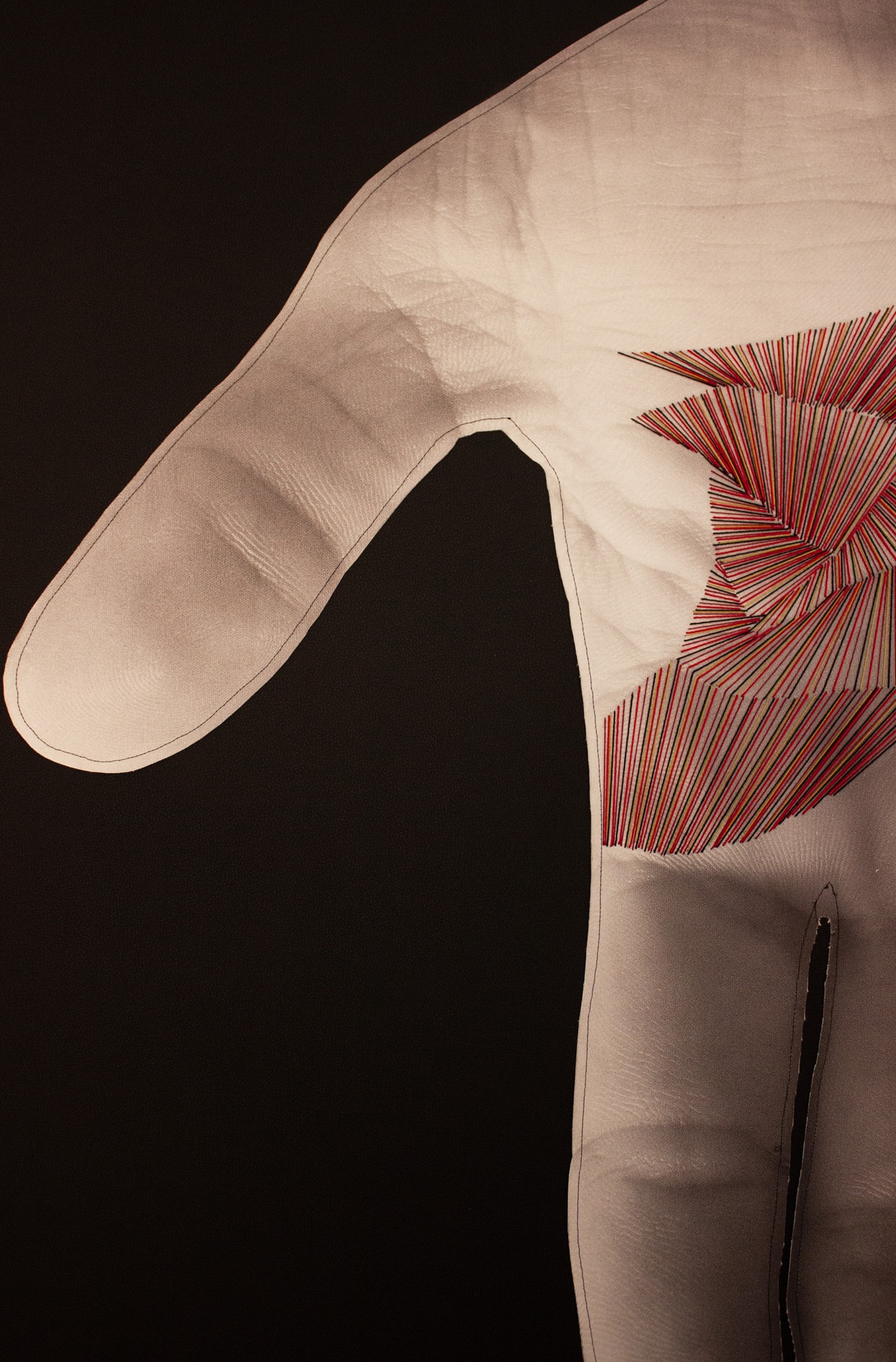
The stitches she observed as a child in the hands of the women of Basilicata – above all her mother and aunts – the early love of drawing, the discipline of painting, photography as a space for listening, and, more recently,
the decision to live with her partner among the Pisan Mountains, in a secluded setting immersed in nature, are not separate episodes in her artistic journey.
They are layers of a single experience that slowly become language. Here, memory does not function as an archive, but as duration: a past that does not close behind the artist, but continues to act in the present, shaping both her gaze and her gesture. Basilicata continues to inhabit her practice not as nostalgia for her origins, but as an inner geography; Tuscany is not a destination, but a new landscape through which that history continues to questionitself. The artist works through layers, returns, and unexpected connections: each stitch holds the time needed for an experience to become knowledge.
The thread does not recall the past; it preserves its generative force. The same is true of colour, which takes part in this same process of distillation.Photography is distilled into a restrained, almost monochromatic palette, where every variation is slight yet necessary, like a brushstroke charged with meaning.
Black and red prevail, interpreted by the artist in a positive sense as containing colours: black is not absence, but depth, shelter, the womb; red is not a wound, but vital force, blood, primal energy. In this tension between shadow and life, colour does not describe: it holds.
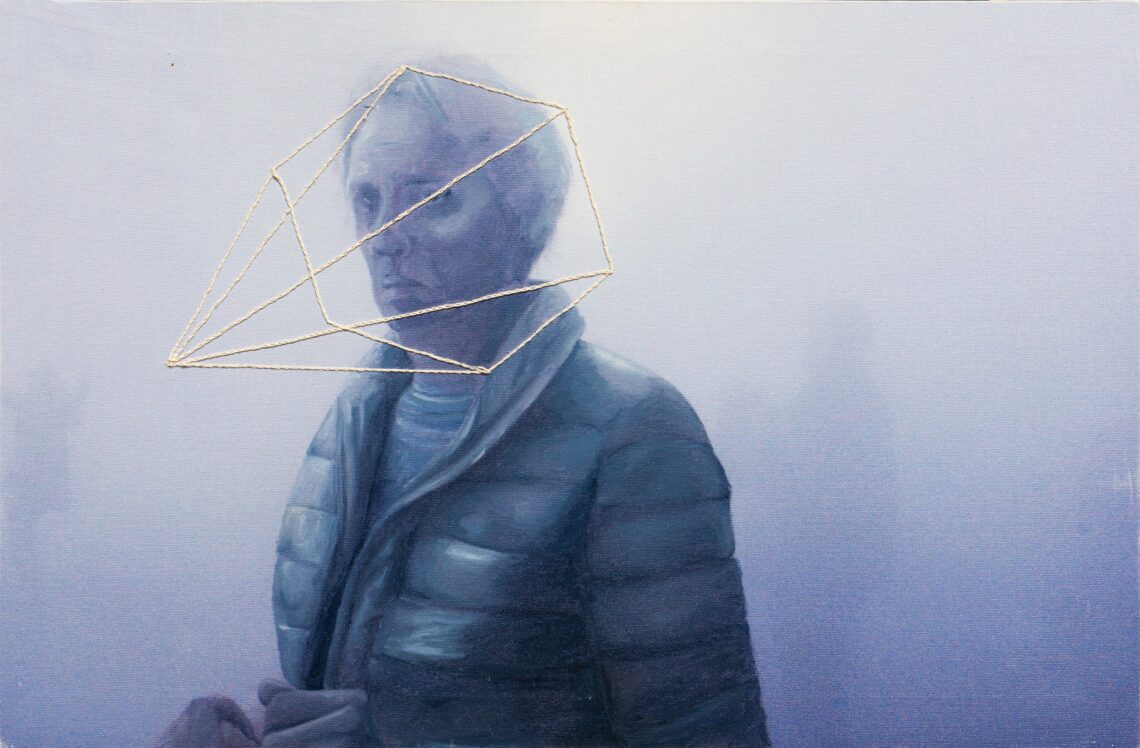
Before this research fully opens onto the landscape, its centre is the body. In her early works, and particularly in the Neoplasie cycle (2018–2019), the body appears as a territory traversed by a malaise that is difficult to name. The figures are immersed in suspended, almost suffocating atmospheres, removed from everyday life and placed in an elsewhere, where solitude becomes an existential condition. Geometric forms, which the artist calls “tumours,” overlap the bodies, making visible what ordinarily remains unseen: the inability to communicate, the unspoken, the sense of inadequacy.
FULL ARTICLE IS INCLUDED IN ATLAS – CHAPTER TWO, AVAILABLE FOR PURCHASE AT WWW.AL3VIEATC.COM/SHOP/ATLAS-CHAPTER TWO/ OR BY CLICKING ON THE COVER