
DEBORAH KRUGER AND THE FEATHERS THAT SPEAK MANY LANGUAGES
| by Armando Garcia Orso | (Curator at the Visions Museum of Textile Art)
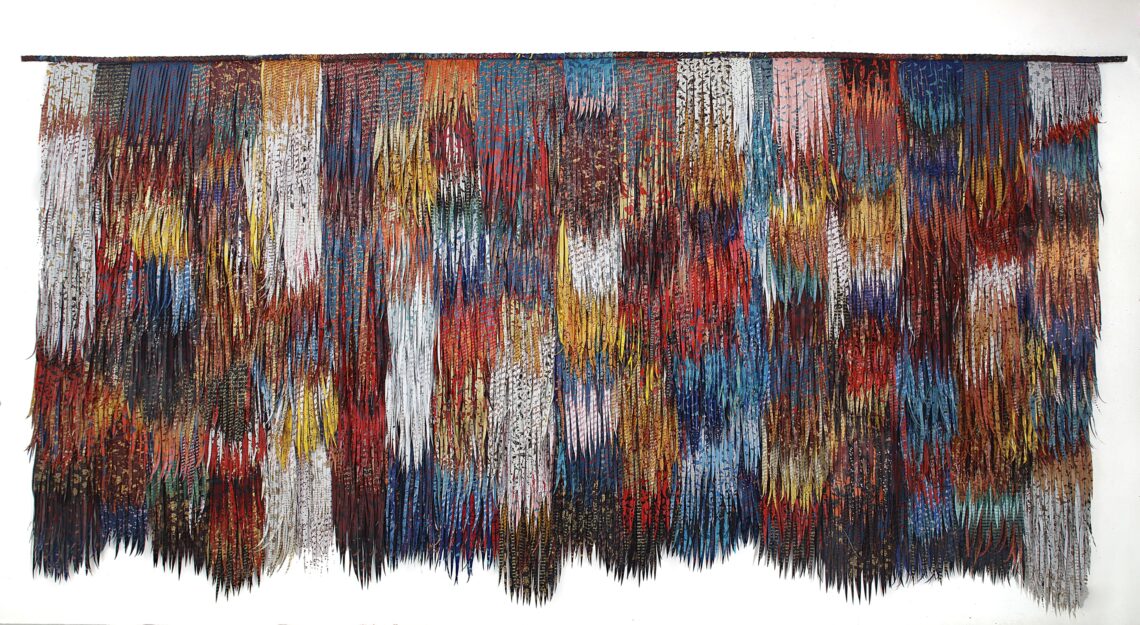
Deborah Kruger is a contemporary environmental fiber artist whose work combines beauty, craftsmanship, and social awareness. Her work resists disappearing into the cold white cube of the gallery. It glows, captures the viewer’s attention, and invites us to recognize familiar textures and colors that recall landscapes etched in our memory. As we move closer, we discover feathers – thousands of them – each inscribed with words in endangered languages such as Purépecha and Yiddish. Like the birds they evoke, these feathers seem to call out, to sing, to demand our attention. Handmade with extraordinary care, they embody both the
fragility and the profound beauty of the natural world we inhabit.
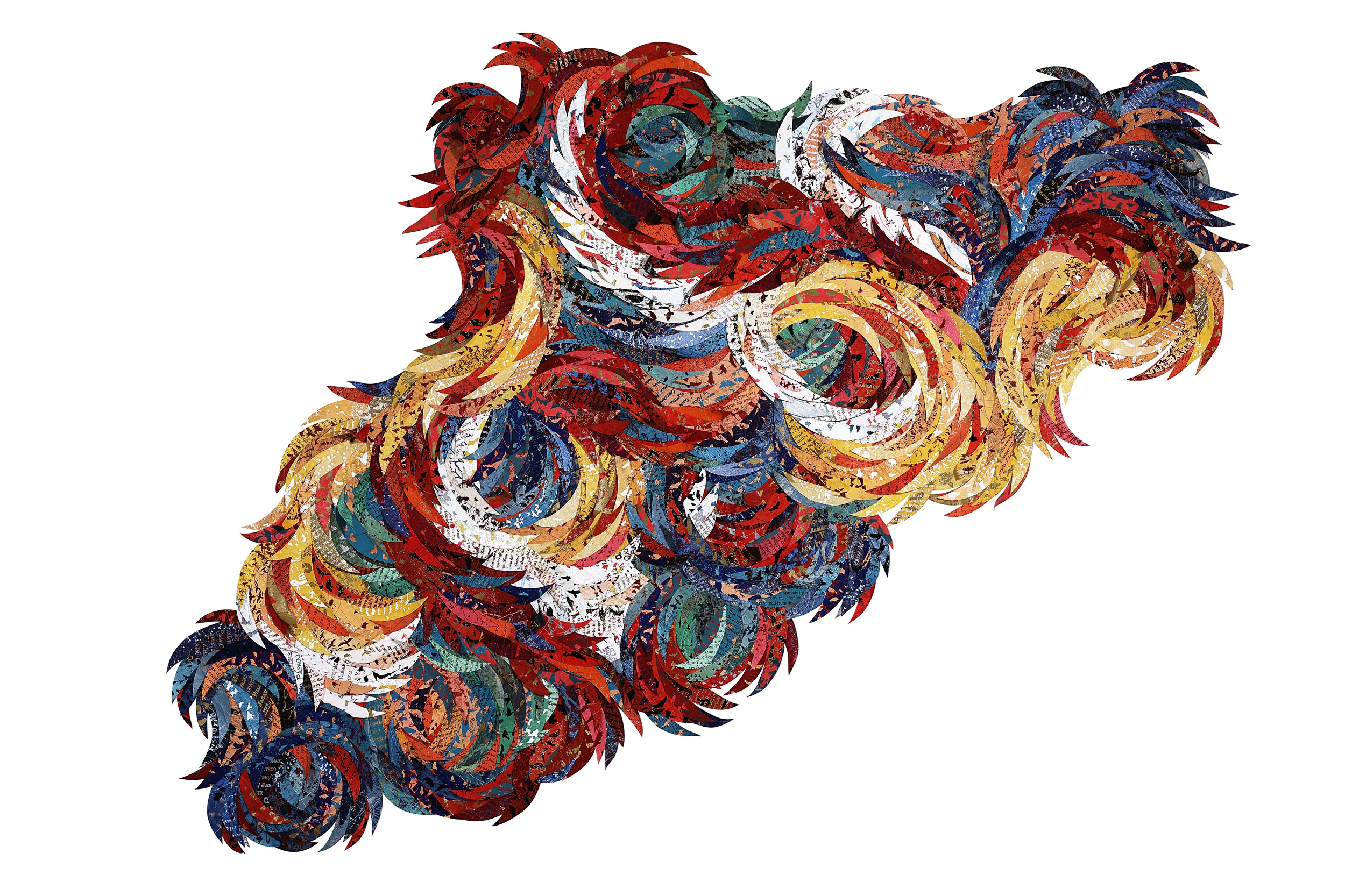
To gain a deeper understanding of Deborah Kruger’s work, you need to appreciate her cultural, social, and geographical context, which are key factors in shaping her style, themes, and artistic technique. Her training in surface design at the Fashion Institute of Technology (FIT) in New York City had a profound impact on her work. Even today, the materials she uses, forms of traditional women’s clothing, and environmental concerns reflect her early exposure to textiles, as she herself has acknowledged. She trained as a textile designer and spent the first eight years of her career designing wallpaper. Thus, patterns, decoration, and design are all part of her visual repertoire. She grew up in an immigrant household that spoke a language now at risk and her grandparents worked in textile sweatshops on the Lower East Side of New York. As she learned other languages, especially Spanish, she realized just how much history, culture and wisdom are embedded in every language.
When Deborah Kruger adopts the form of the huipil in her exhibition EXTINCTIONS at the MUMA Civico Museo Parisi Valle (Maccagno, Italy), she invokes one of Mesoamerica’s most enduring textile traditions. As both garment and cultural archive, the huipil bears witness to the histories, identities, and resilience of Indigenous communities throughout Mexico and Central America.
FULL ARTICLE IS INCLUDED IN ATLAS – CHAPTER TWO, AVAILABLE FOR PURCHASE AT WWW.AL3VIEATC.COM/SHOP/ATLAS-CHAPTER TWO/ OR BY CLICKING ON THE COVER