ECOLOGIES OF MAKING. THE KNOWING BODY: ELENA REDAELLI AT THE ART SITE OF THE RAILWAY WAREHOUSE, HSINCHU
Ecologies of Making begins with the premise that to know a place is to make with it. Arriving opens an evolving process of discovery, much of which cannot be planned or anticipated. It begins with observing and listening, and develops through relationships with the people who live there, their culture, and the histories embodied in local materials and infrastructures. For the artist, knowing is a bodily experience mediated by touch and familiar movements. The exhibition traces this process of discovery through the projects developed by Elena Redaelli in Taiwan since the beginning of her residency programme at the Art Site of the Railway Warehouse. Together, the works reveal a practice shaped by material encounters and relationships formed over time.
The gesture of making is the point at which a sensing body meets matter and curiosity arises. From pulling a rope to repeatedly folding paper, each movement is rooted in a particular material history while belonging to a wider bodily language. Through touch and repetition, movements become embodied and pass between people. As hands respond to matter, form grows alongside shared knowledge. This knowledge cannot be separated from the act of making; it resides in a body that learns how to respond. Making becomes a language held in common, connecting artistic practice with everyday labour.
Each work takes form within a wide field of relations in which materials, animals, inherited histories, and less visible forces of the environment also participate, extending collaboration beyond human participants. As María Puig de la Bellacasa writes, “nothing holds together without relations of care” (2017, 67). Care lies in sustaining a process while remaining attentive to each of its participants. As materials pass between hands, knowledge circulates without being detached from the lives and circumstances from which it emerged. The resulting forms retain the marks of these encounters, opening individual authorship to shared experience.
Each material enters the exhibition with a history to tell and its own, sometimes stubborn, behaviour. Jane Bennett names this force “Thing-Power: the curious ability of inanimate things to animate, to act, to produce effects dramatic and subtle” (2010, 6). Matter is therefore not a passive support: it redirects the making and continues to change beyond the artist’s intervention. Concrete retains a detailed image of the body. Oyster shells carry the smell and memories of coastal lives within changing ecologies. Discarded PVC banners and safety nets from Taiwanese highway construction sites bear traces of local industry, while paper found in its place of production records repeated touch and gradual weathering.
These materials become living records of place, brought together in an exhibition that unfolds as an evolving journal. Their meanings remain open, continuing to change as the works are handled, repositioned, and perceived by different people. The exhibition brings these traces into relation through the gestures that activate them, asking how materials speak to one another and how making may also bring people into relation.
The exhibition brings together five projects developed in different locations across Taiwan during 2026. Each originates in a specific landscape and in a process of encounter with its materials, communities and environmental conditions. Repositioned within the exhibition space, the works retain the traces of their original contexts while entering new relationships with one another.
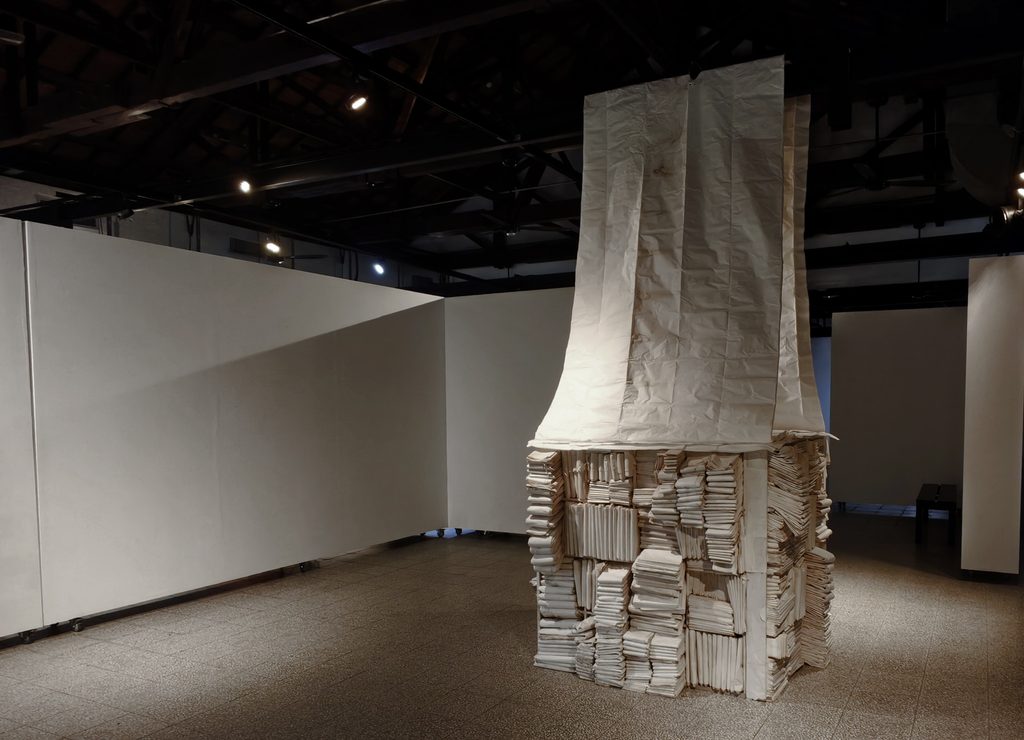
The first of these projects, Years of Paper, began with a large roll of paper from the site of Yilan’s former paper mill. Developed for the 2026 Art Maker Festival: The Eco-Museum of Books, held between July and September 2026 at Zhongxing Cultural and Creative Park, Wujie Township, Yilan County, the work emerged through a daily gesture of unfolding and refolding. During the installation period, the paper was gradually unfolded and repeatedly refolded until pages emerged within the building’s empty windows.
This daily gesture became the first chapter of the work. As the paper was handled and transformed, it accumulated traces of its making. Some remained visible, while others were concealed within the folds. Over the following two months, the pages remained open to further transformation. Exposed to changing weather, the paper continued to register the passage of time. The work approaches the book not as a container of text but as a material surface upon which time is written.
Presented again in this exhibition, the pages reveal the marks left by daily handling and environmental change. They also carry the encounters that gathered around the work. Between their visible surfaces and concealed folds, they form a book of time shaped by the gestures of making and the weather of that place.
A different relationship between material, community and environment emerges in Cheng Long Oyster Village – A Floating Shelter for Migratory Birds and Small Wetland Lives, developed for the 2026 Cheng Long Wetland Art Festival: Entering the Wetland in May 2026 at Cheng Long Wetland, Kouhu Township, Yunlin County, Taiwan.
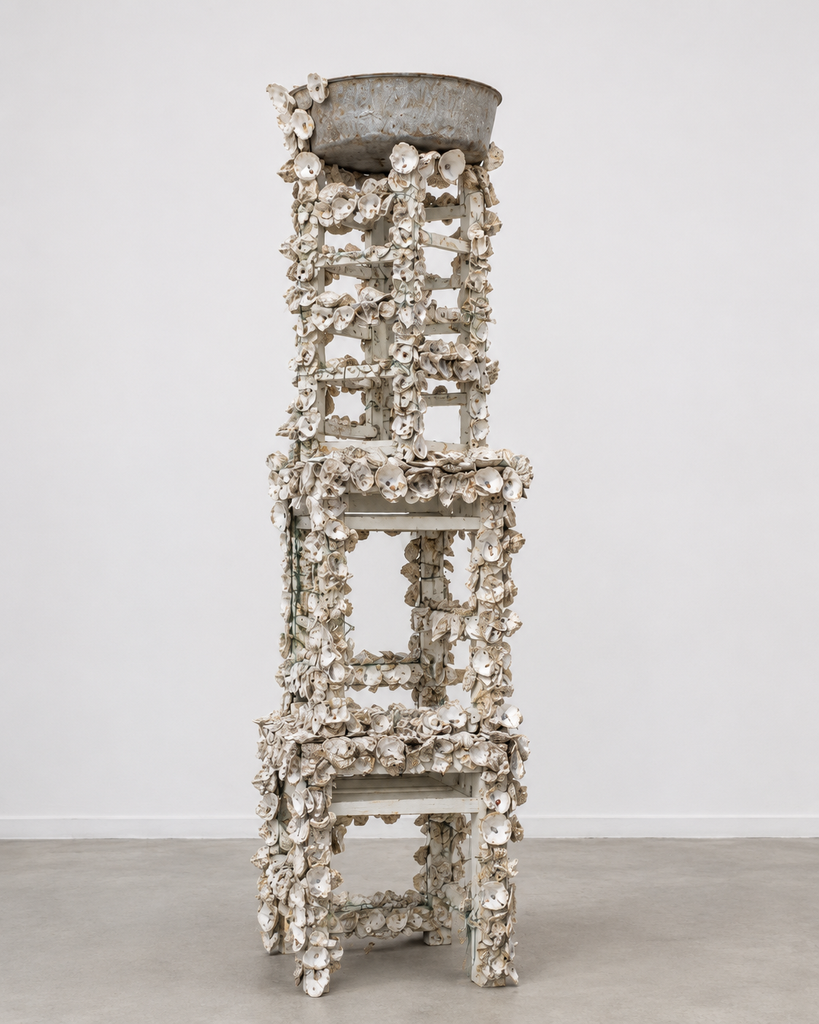
The work emerged as a floating island of oyster shells formed around discarded wooden chairs and tables from the local elementary school. Rising from humid ground and tidal water, it became a resting place for migratory birds. The spaces between the shells also offered refuge to smaller forms of wetland life.
The work grew through a long-term relationship with Cheng Long Village. Conversations with Pei-Chen Lin, a villager and member of the Cheng Long Community Development Association, shaped its attention to local histories and material ecologies. Oyster shells and oyster powder carry stories of coastal labour, becoming a point of encounter within the village. People of different generations took part in assembling the work, sharing local knowledge through making. Presented again in this exhibition, the oyster-covered pieces of old furniture retain the marks of that collaboration and carry the material presence of the wetland into a new place.
The relationship between collective gestures and the coastal landscape also lies at the heart of Saltwater Atlas, a site-responsive installation developed by artists Karin van der Molen and Elena Redaelli with more than 150 participants, including visitors to and friends of the Art Site of the Railway Warehouse. The work was created for the 2026 Taoyuan Land Art Festival, held between July and August 2026 at the Xinwu Stone Weir Exhibition Area, Taoyuan, Taiwan.
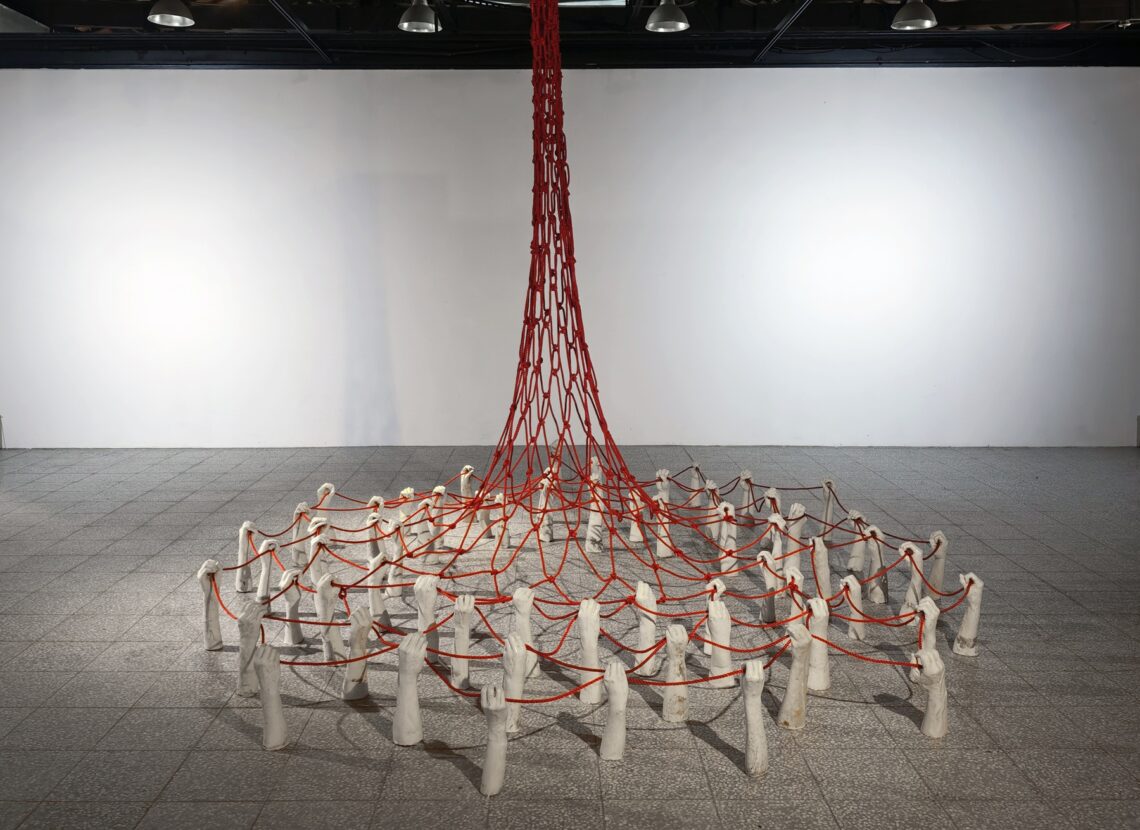
During a series of workshops, participants cast their forearms and hands in gestures of holding or pulling a rope. Made from white cement mixed with oyster-shell powder, the 150 casts formed a boat-shaped oval field, each hand gripping a continuous red marine rope.
The work mapped the Pearl Coast not as scenery, but as a living threshold between land and sea. Connecting the hands to one another and extending towards the shoreline, the rope created a visible system of tension. It recalled lines used for mooring or fishing while also evoking borders and lifelines. In this atlas, each line held a double meaning, supporting daily sustenance while marking movement or control.
Water sustains coastal communities through fishing and trade, yet it is also a geopolitical surface across which access and passage are contested. In a landscape where ecological conservation intersects with industrial infrastructure, the work asks what it means to share water as a commons and who is allowed to cross it or depend upon it.
The repeated but distinct hands make distributed labour and shared dependence visible. Their gestures suggest many bodies holding and maintaining a common structure. The red rope becomes connective tissue through which individual actions are woven into a communal story.
Before the festival opened, advancing water and coastal erosion forced the first installation to be dismantled. It was later reassembled in a safer position, with the damaged casts remade. This unplanned displacement became part of the work’s history, showing how the landscape could act upon the installation and redirect its form.
Presented again in this exhibition, part of the network leaves the coastal landscape and enters a space dedicated to art. The casts retain both the individual forms of the participants’ hands and the sand accumulated during more than two months of exposure outdoors. The rope continues to hold their gestures in relation. Alongside the work, the participants’ names are displayed.
The gestures of labour and the transformation of everyday materials also inform Another Landscape – Emerging Green, a site-specific installation developed for the Provincial Highway 76 Extension Public Art Project D (風起台七六,海野山共行) in August 2026, beneath Provincial Highway 76, Changhua County, Taiwan.
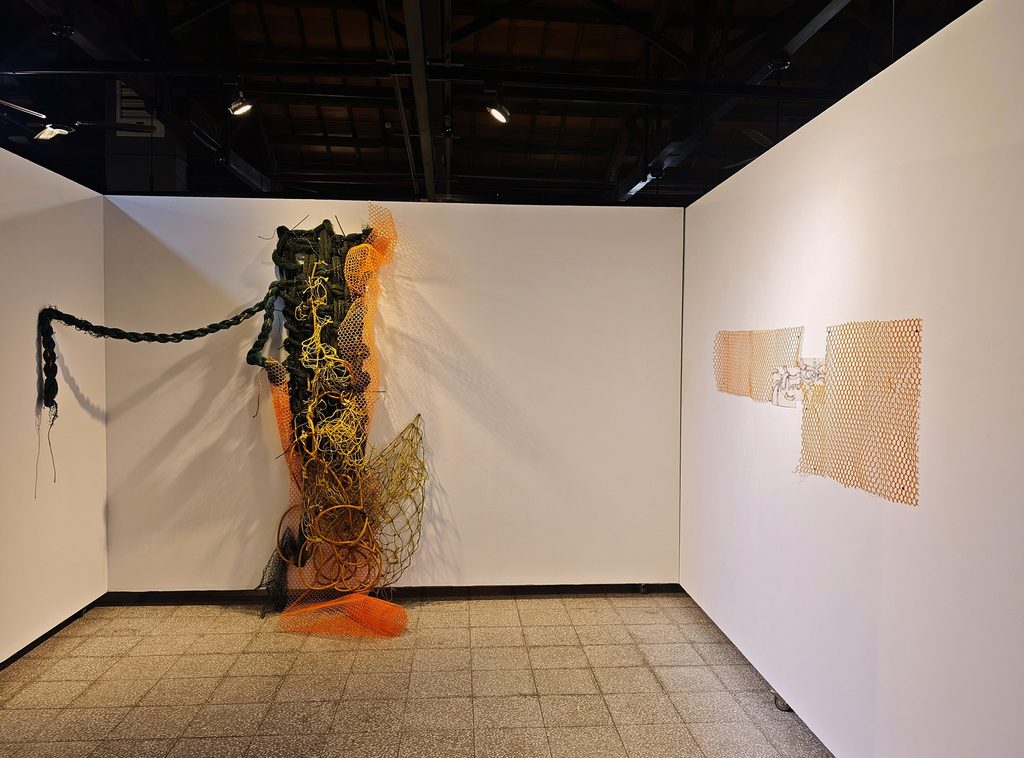
Reclaimed construction netting forms the base of the work. Plastic tubes and sections of orange mesh are woven and knotted through it, creating a large sculptural surface that dresses a concrete pillar. The work draws upon knowledge held in the hands of construction workers, whose gestures bind and secure the material structures of this region. Through weaving, these gestures of labour are transformed into a collective textile language. Everyday construction materials acquire another use, while the shared process creates a space to exchange knowledge and experience.
Beneath the weight of the highway, a flourishing agricultural landscape continues to emerge. Green dominates the surface, interrupted by yellow and orange. These colours recall the rice fields and fruit trees growing around the infrastructure. Suspended against the grey concrete, the woven surface reveals the persistence of this living landscape.
Touched by wind and changing light, the installation introduces softness and colour into the monumental structure of the highway. Discarded materials become active again, carrying traces of labour and place while suggesting another landscape within the existing one. Presented in this exhibition through a section of its woven surface, the work leaves the scale of the highway and enters the gallery. The new piece retains the gestures of its making and proposes that discarded materials, usually considered only in terms of their utility, can become beautiful elements within an artwork.
The final project, Intertidal Carapaxia – Wetland Future Fossils, developed for the 2026 Siangshan Wetland Art Festival in September 2026 at Siangshan Wetland, Hsinchu, Taiwan, extends the investigation of material ecologies towards the forms and rhythms of non-human life.
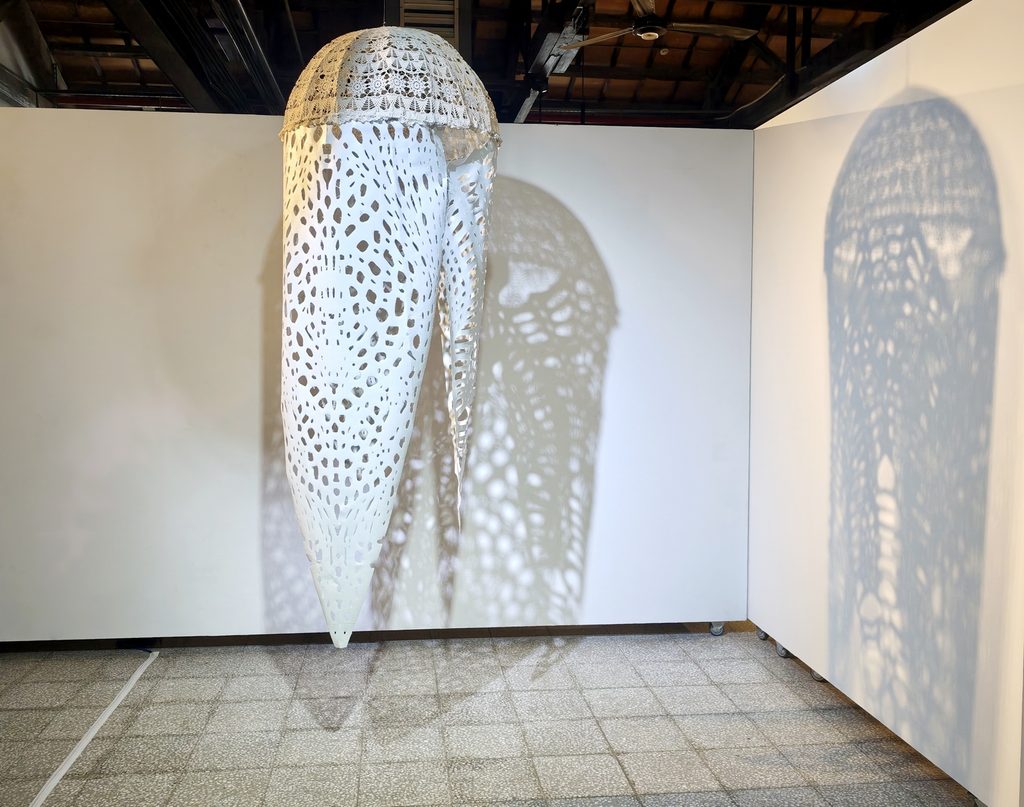
Intertidal Carapaxia is a large-scale, site-responsive installation conceived for Xiangshan Wetland. Its dispersed body emerges from modular metal structures covered with white membranes cut from recycled advertising banners. Their perforated patterns recall crochet while echoing the forms of diatoms and Taiwan’s endemic fiddler crab.
The installation appears like the skeletal remains of an unknown organism emerging from the landscape. Its form is shaped by the life of the wetland, where species endure rapid changes in salinity and water levels. Many survive by burrowing into the mudflat, moving between submerged and exposed ground. The curved structures of Intertidal Carapaxia translate these movements into the body of an imagined future fossil.
The use of discarded synthetic material connects the fragility of the wetland with remnants of human activity that resist decomposition. Framed as a future fossil, the work asks what may remain when erosion and ecological pressure continue to reshape this habitat.
In this exhibition, the project is reinterpreted through a large white cotton crochet piece from Italy, accompanied by drawings of the endemic fiddler crab. The crochet was the work’s initial inspiration; its fractal structure echoes the way natural forms develop in space. Set against a black surface and placed alongside the wetland’s creatures, this example of women’s craft travels from Italy into dialogue with Taiwan’s endemic fauna.
Across these five projects, making emerges as a way of knowing that is inseparable from the body, from the material conditions of a place and from the relationships that develop through time. Paper, oyster shells, concrete, construction netting, synthetic membranes and cotton crochet do not simply provide the means through which an idea takes shape. They participate in the process, carrying histories, responding to environmental forces and retaining the gestures of those who have worked with them.
The exhibition brings together these different material encounters without separating them from the circumstances in which they originated. Instead, it allows their histories to remain present, while opening them to further relations within the gallery. What emerges is an evolving journal of gestures, exchanges and transformations, in which individual artistic practice meets collective knowledge and the agency of matter. Ecologies of Making proposes making as a situated and relational form of knowledge, one that unfolds through the hands and remains attentive to the many human and more-than-human lives that shape a place.
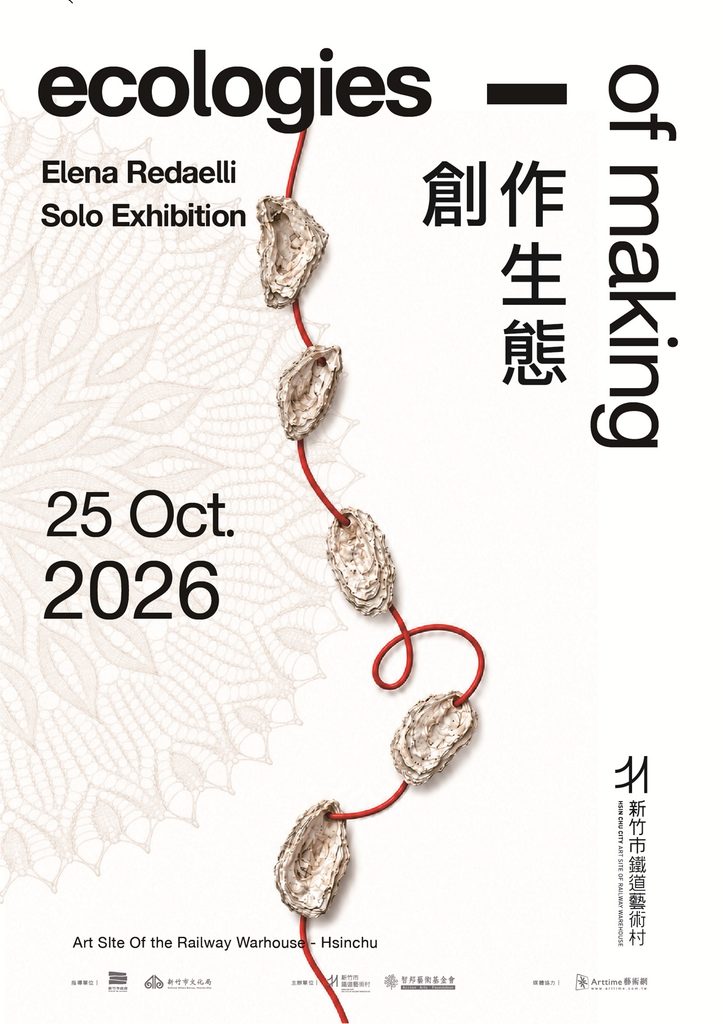
The exhibition period runs from 25 October through 25 November 2026 at Art Site of the Railway Warehouse, Hsinchu, Taiwan
References
- Bennett, Jane. Vibrant Matter: A Political Ecology of Things. Durham, NC: Duke University Press, 2010.
- Puig de la Bellacasa, María. Matters of Care: Speculative Ethics in More Than Human Worlds. Minneapolis: University of Minnesota Press, 2017.


