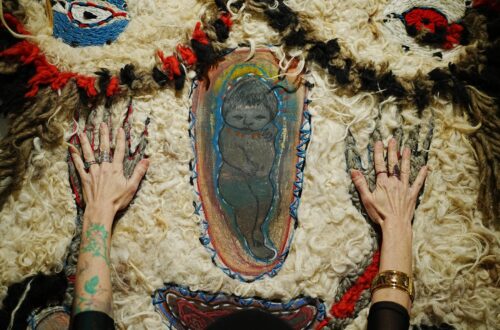

LE FIL VOYAGEUR. TOLD BY SHEILA HICKS AND MONIQUE LÉVI-STRAUSS
The exhibition Le fil voyageur, presented at the Atelier Martine Aublet inside the Musée du Quai Branly – Jacques Chirac from September 30, 2025, to March 8, 2026, retraces sixty years of friendship and creative dialogue between Sheila Hicks, artist and pioneer of textile art, and Monique Lévi-Strauss, historian of textile arts. It represents a unique occasion for an unprecedented encounter between Sheila Hicks’s works, for which the ancient Andean textiles are a source of inspiration, and the textile artifacts of the Museum itself.
Le fil voyageur presents a selection of Sheila Hicks’s works of varying dimensions — from the smallest, belonging to the Minimes series, to the most monumental — placed in dialogue with the pieces from the museum, chosen by the artist, originating from Latin America. Through these encounters, a history of textiles emerges, one that crosses borders, civilizations, eras, and beliefs.

Two women passionate about textiles
Born in 1934 in Hastings, Nebraska, Sheila Hicks studied visual arts at Yale University, where she trained with Josef Albers, a central figure of the Bauhaus and modernism. Very early on, she became familiar with the techniques and complex structures of pre-Columbian weaving, guided by her professor George Kubler and the archaeologist Junius Bird, who introduced her to the research and publications of the textile specialist Raoul d’Harcourt. Thanks to a grant obtained to teach at the Universidad Católica in Chile, she traveled to Venezuela, Colombia, Ecuador, Peru, Argentina, and Brazil. After receiving a second scholarship in France, she settled in 1959 on a beekeeping ranch in Mexico, before moving permanently to Paris in 1964.
Sheila Hicks and Monique Lévi-Strauss met in Paris in 1968. From their friendly conversations and their shared interest in textiles came, in 1973, the first monograph devoted to Sheila Hicks’s work, which was also the first title published by Monique Lévi-Strauss. Today out of print, it has been republished on the occasion of this exhibition.
Specialized in the study of cashmere shawls, of which she is also a collector, Monique Lévi-Strauss organized in 1998 the remarkable exhibition Cachemires parisiens at the Palais Galliera – Musée de la Mode de la Ville de Paris, crowning several decades of work.
Thanks to her studies and her travels, Sheila Hicks has developed, since the late 1950s, a textile practice that challenges artistic categories and traditional hierarchies. Heir at once to the modernist spirit and to very ancient techniques, she reinterprets fundamental gestures such as knotting, weaving, braiding, wrapping, twisting. Within the exhibition, her work takes on new scope through the encounter between her creations and the rich Andean textile vocabulary, expressed in pompoms, ikats, tapestries, and looms present in the museum’s collections. Le fil voyageur highlights these works alongside a group of drawings, maps, slideshows, as well as photographic archives and audiovisual elements never before presented together.
The exhibition is curated by Isaline Saunier, Technical Research Manager for the Textile Collections at the Musée du Quai Branly – Jacques Chirac, in dialogue with Sheila Hicks, textile artist, and Monique Lévi-Strauss, textile historian, with the valuable collaboration of the Atelier Sheila Hicks for the loan of the works.
The itinerary opens with a wall of Minimes, true small creative travel notebooks by Sheila Hicks, and continues by illustrating the links between textiles and architecture, juxtaposing the artist’s suspended works with tapestries from archaeological cultures of Peru. It proceeds with the Andean practice of wrapping and its contemporary reinterpretations by the artist. A third section is dedicated to ikat techniques, in which dyed threads create chromatic effects and bindings produce rhythmic intervals alternating suppleness and rigidity. The exhibition continues with pompoms, both archaeological and sculptural, ancient looms, and four-selvedge works, before concluding with a wide variety of belts and the practice of knotting, emblematic of Andean societies and reinterpreted by the artist as a gesture of discovery and meditation.

The Atelier Martine Aublet
Inside the Musée du Quai Branly – Jacques Chirac, the Atelier Martine Aublet is an innovative space deeply open to artistic experimentation. Located on the central mezzanine, at the heart of the Collections floor, this 170-square-meter space offers an exceptional view of the 3,500 works from the permanent collections. Since June 2012, it has hosted three installations a year linked to the life of the collections, in a form that allows for unexpected and offbeat events compared to the museum’s programming: new acquisitions, invitations to contemporary artists, scientists, portraits of personalities, and non-Western contemporary photography.
“The challenge was to work on another scale of intervention, to create a place capable of generating different emotions and sensations in the way exhibitions are conceived and experienced, but also a highly plastic space capable of taking different forms,” summarize its creators, Grégoire Diehl and Thierry Payet. More than a classic exhibition space, the Atelier Martine Aublet is above all a cabinet de curiosités, offering the possibility of an encounter between the universe of a personality and the museum’s collection.
The Fondation Martine Aublet
The Fondation Martine Aublet “Agir pour l’éducation” was created in September 2011, in the aftermath of Martine Aublet’s passing. Presided over by Bruno Roger, the Foundation perpetuates Martine Aublet’s commitment. It operates on three axes, all in dialogue with the museum: the awarding of scholarships to students in the Humanities at three key stages of their academic careers; the financing of the exhibitions of the Atelier Martine Aublet, created and produced by the museum; the awarding of a literary prize to a work linked to non-Western cultures.
In 2021, the tenth anniversary of the Fondation was celebrated, and on that occasion, the Minister of Culture Roselyne Bachelot awarded the Fondation Martine Aublet the distinction of “Grand mécène de la Culture.”
The Musée du Quai Branly – Jacques Chirac (37 quai Branly, 218 et 206 rue de l’Université) in Paris is open every day, except Monday, from 10:30 a.m. to 7:00 p.m., and on Thursdays until 10:00 p.m. Info: www.quaibranly.fr