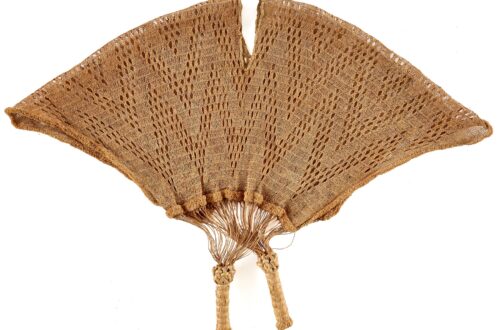

MAGDALENA ABAKANOWICZ: LA TRAME DE L’EXISTENCE
Until April 12, 2026, the Musée Bourdelle in Paris is hosting the first major retrospective dedicated to Magdalena Abakanowicz in France. A central figure of the 20th-century Polish art scene, Abakanowicz (1930–2017) experienced war, censorship, and deprivation under the communist regime from an early age. Her oeuvre, characterized by immersive, poetic, often unsettling textile works and sculptures of strong political resonance, explores the relationship between body, memory, and material. Inspired by the organic world, seriality, and monumentality, her art possesses undeniable force and presence, resonating with contemporary issues—environmental, humanistic, and feminist. Radical and pioneering, her career led her to exhibit regularly abroad, from the United States to Japan and across Europe, with recent shows at the Tate Modern in London and the Musée cantonal des Beaux-Arts in Lausanne.

The Musée Bourdelle presents a chronological and thematic journey composed of 70 ensembles—including 33 sculptural installations, 10 textile works, drawings, and photographs—offering biographical and historical keys to understanding the context and evolution of her artistic practice.
In the 600 m² of the Portzamparc wing, whose concrete walls have been specially renovated, the exhibition emphasizes Abakanowicz’s sculptural production, reinstating her role among the great sculptors of the 20th century. The exhibition subtitle, La trama dell’esistenza, combines two terms the artist herself used to define her work: she conceived of fabric as the elemental organism of the human body, marked by the highs and lows of destiny.


The project, the result of three years of work, is actively supported by the Marta Magdalena Abakanowicz Kosmowska and Jan Kosmowski Foundation in Warsaw, the Polish Institute, and the Adam Mickiewicz Institute. Key lenders include the Marta Magdalena Abakanowicz Kosmowska and Jan Kosmowski Foundation in Warsaw, the Toms Pauli Foundation in Lausanne, the Central Museum of Textiles in Łódź, the Tate Modern in London, the Museum of Contemporary Art in Krakow, and the Musée d’Art Moderne in Paris.
The exhibition journey begins in the street-facing garden, where the monumental Grande figure welcomes visitors. In the corridor of the Portzamparc wing, the first section offers an overview of Abakanowicz’s vast production, with early textile works, small-scale sculptures (often anatomical), drawings, and public-space projects.

This is followed by the cycle of monumental works begun in the 1960s: the Abakans, spectacular textile pieces suspended from the ceiling. Despite material scarcity, the artist created them from natural fibers and recycled fabrics folded beneath her bed, transforming deprivation into creative force.
In the 1970s, Abakanowicz’s practice shifted focus to the human figure and the principle of seriality, developed through Dos and Figures dansantes. The third section of the exhibition examines these identity-less shells, questioning presence and absence. The fourth section presents the iconic installation Embryology, shown at the 1980 Venice Biennale: between body, organic matter, and rock, the accumulated forms immerse the viewer in an ambiguous and hybrid space. The drawings and reliefs of Paysages highlight the materiality of her works and her interest in metamorphosis.

In the museum’s concrete compartments, the exhibition continues with the ensembles of the Mutants and La Foule V. While the Mutants occupy space indeterminately, the anonymous and unsettling crowd of La Foule V embodies Abakanowicz’s reflection on “the crowd as a brainless organism.”
The exhibition concludes with the monumental cycle Jeux de guerre, composed of massive tree trunks encircled by steel rings, evoking the destructive power of war and reinforcing the symbolic force of an artist unique in the second half of the 20th century.
Throughout the exhibition, explanatory panels and labels guide visitors, with translations in English and Polish. Family-friendly illustrated labels are also provided, featuring the famous Mutants. A digital path in the museum app offers texts written by the artist herself.

Excerpts from the film Abakany (1969), produced by Abakanowicz in collaboration with filmmaker Jarosław Brzozowski, are projected, showing the Abakans deployed across the lunar-like landscape of the Baltic Sea. Previously unseen footage from the artist’s studio, presented exclusively for the exhibition, offers an intimate insight into Magdalena Abakanowicz’s creative process.
At the end of the path, a material library allows visitors to explore the materials and techniques used by the artist, such as weaving plant and animal fibers (wool, cotton, jute, sisal, horsehair, linen, hemp…).
The exhibition catalogue, enriched with contributions from international experts in modern and contemporary art, sculpture, and textile art, highlights the artist’s modernity in the context of her life and the conditions of creation under the communist regime in Poland. It includes detailed entries on all works in the exhibition and emphasizes the uniqueness and power of Abakanowicz’s production in relation to her contemporaries.
THE MUSÉE BOURDELLE
A contemporary of Rodin and Maillol, Antoine Bourdelle (1861–1929) developed a powerful style, culminating in his masterpiece Héraklès archer. Recognized in his lifetime as one of the great French sculptors, particularly in monumental art, he received prestigious commissions, such as the Monument to General Alvear in Buenos Aires.

The Musée Bourdelle occupies the spaces the artist used for over 40 years, in Montparnasse’s so-called cité d’artistes. With success, he gradually expanded his studios. His wife Cléopâtre and daughter Rhodia played a key role in opening the museum in 1949. Some spaces, such as the sculpture studio, have been preserved in exceptional condition.
The museum layout revolves around two gardens populated with sculptures. Under the arches of the street-facing garden, the Hall des plâtres houses the monumental works. At the end of the portico, a pavilion accommodates the painting studio. Through a covered passage, a door leads to the collection route, with rooms arranged around the inner garden. Opposite, the fully preserved sculpture studio and the room dedicated to sculptural techniques can be found. The route concludes with a walk through the garden, while temporary exhibitions are presented in the contemporary wing designed by Christian de Portzamparc.
The museum reopened in March 2023 after two years of renovation. The Hall des plâtres was also refurbished and reopened in March 2025.