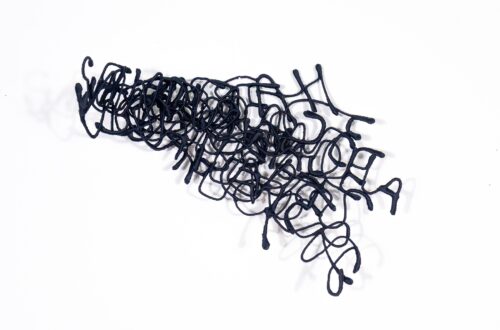

ANNI ALBERS. CONSTRUCTING TEXTILES
Until 22 February 2026, the Zentrum Paul Klee in Bern is presenting Anni Albers’ first solo exhibition in Switzerland. Entitled Anni Albers. Constructing Textiles, the exhibition offers an in-depth reappraisal of one of the most influential figures of twentieth-century art and design, capturing the complexity of a practice that transformed weaving into a site of convergence between formal experimentation, theoretical reflection, and architectural thinking.

Photo: Philipp Ottendörfer. © 2025 The Josef and Anni Albers Foundation/ProLitteris, Zurich
Trained at the Bauhaus in Weimar, Dessau, and Berlin, Anni Albers developed from the outset a conception of textiles that stood in radical opposition to traditional disciplinary hierarchies. For her, weaving was not a subsidiary craft subordinated to the so-called major arts, but rather a structural device capable of articulating space, function, and perception. Following the closure of the Bauhaus under pressure from the National Socialist regime, her emigration to the United States in 1933 marked a decisive turning point. The experience at Black Mountain College – within an educational context grounded in interdisciplinarity and experimentation – provided Albers with the ideal environment in which to consolidate a line of inquiry that would exert a lasting influence on twentieth-century visual culture.
A decisive role in the formation of her method was played by the teaching of Paul Klee, who from 1927 onward introduced theoretical design instruction into the weaving workshop. In the absence of codified technical training, the young Bauhaus weavers were encouraged to engage directly with materials, developing a practice based on observation and experimentation. This operational freedom, combined with rigorous formal reflection, accompanied Anni Albers throughout her career, resulting in an approach that conceived weaving as construction, structure, and language.

© 2025 The Josef and Anni Albers Foundation/ProLitteris, Zurich
From the 1930s onward, Albers’ travels in Latin America – particularly to Mexico, Chile, and Peru – further expanded the scope of her research. Her engagement with pre-Columbian textile traditions, previously encountered through the study of ethnographic collections in European museums, became a direct and deeply formative experience. The richness of motifs, techniques, and symbolic systems found in Andean and Mesoamerican textiles was reworked autonomously in Albers’ own practice, translated into a contemporary visual language free of any literal or citational intent.

Photo: Tim Nighswander / Imaging4Art Private Collection
© 2025 The Josef and Anni Albers Foundation/ProLitteris, Zurich
It was in this context that Ancient Writing (1936) was created, one of the earliest examples of her pictorial weavings. Here, an open weave traversed by irregular bands of black rayon becomes a surface of inscription, evoking archaic writing systems and archaeological signs. Textile emerges as a semantic space, capable of articulating an autonomous visual language. The theme of writing also runs through later works such as Code (1962), inspired by the Andean khipu: knots and supplementary threads suggest an encrypted system of communication in which meaning is constructed through rhythm, structure, and variation. After 1963, these investigations extended to works on paper, where knots, lines, and woven structures were explored as graphic and conceptual elements.

The Museum of Arts and Design, New York, gift of Karen Johnson Boyd, through the American Craft Council, 1977. © 2025 The Josef and Anni Albers Foundation/ProLitteris, Zurich
Alongside her artistic production, Anni Albers pursued extensive applied research devoted to the design of textiles for architecture and interior spaces. Far from being conceived as merely decorative coverings, these works respond to precise functional requirements and emerge from careful analyses of materials and spatial conditions. A paradigmatic example is the sound-absorbing wall covering designed in 1930 for the auditorium of the General German Trade Union Federation in Bernau, where the combination of chenille and cellophane translated an acoustic problem into a formal solution of striking modernity. This experimental approach, open to the use of unconventional materials, remained a constant throughout her practice.

© 2025 The Josef and Anni Albers Foundation/ProLitteris, Zurich Courtesy The Josef and Anni Albers Foundation and David Zwirner
In the United States, Albers collaborated with leading architects, among them Walter Gropius, for whom she designed textiles between 1948 and 1950 for the dormitories of the Harvard Graduate Center. In these projects as well, she demonstrated how textiles could actively shape spatial experience, reconciling functionality, durability, and aesthetic quality. A similar sensitivity is evident in her works for sacred contexts, such as the Lurex panels created in 1957 for Temple Emanu-El in Dallas, where the textile surface becomes a dynamic element responsive to light and movement.
Institutional recognition came as early as 1949 with her solo exhibition at the Museum of Modern Art in New York, the first ever devoted to a textile designer. The prototypes presented on that occasion, including suspended spatial partitions, embodied a vision of textiles as fully fledged architectural elements, capable of replacing or complementing traditional walls. It is therefore no coincidence that Anni Albers repeatedly claimed an autonomous projectual role for textiles, describing them as “contributing ideas” within architecture.
This vision finds concrete expression in the exhibition design at the Zentrum Paul Klee, where selected textiles are installed as spatial devices in direct dialogue with the museum’s architecture.

© 2025 The Josef and Anni Albers Foundation/ProLitteris, Zurich
Curated by Fabienne Eggelhöfer and Brenda Danilowitz in collaboration with the Josef and Anni Albers Foundation, Anni Albers. Constructing Textiles affirms the contemporary relevance of a body of thought that continues to interrogate the relationship between art, material, and space, reaffirming textiles as a critical field of inquiry and as a medium capable of redefining the very categories of contemporary artistic practice.