
MIRIAM MEDREZ: WEAVE UNFOLD PLEAT
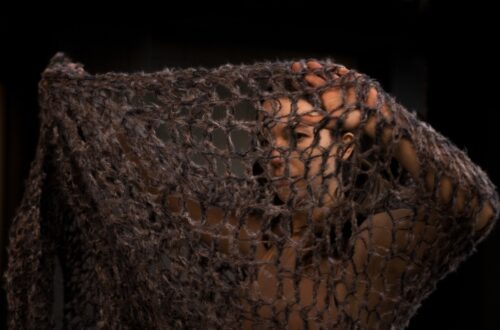
The exhibition Weave Unfold Pleat (Entramar desdoblar plisar), curated by Virginie Kastel Ornielli and presented at the Centro de las Artes in Monterrey from August 7 to October 26, 2025, offers a broad and multilayered reading of the path that Miriam Medrez has pursued for fifteen years in the field of textiles. After her beginnings as a ceramic sculptor, the artist, born in Mexico City in 1958 and settled in Monterrey since 1985, chose fabric and thread as her privileged tools to articulate a research which, while constantly transforming, preserves the continuity of a sculptural practice rooted in the relationship between body, matter, and symbol. Her language is founded on three actions that serve as conceptual and aesthetic devices—weaving, unfolding, pleating—which, beyond generating forms, open horizons of meaning connected to nature, the female body, and domesticity, three constant poles of her production.

Medrez addresses these themes with a practice that combines rigor with openness to experimentation, alternating figuration and abstraction. Her figurative works investigate the female condition, both in its intimacy and in the social pressures that run through it: Talla O alludes to contemporary obsession with thinness through an installation of lettuces, carnivorous plants, and suspended plates, while Quién se come a quién stages the food chain as an allegory of the female body – permeable, fluctuating between domestic and wild dimensions. Conversely, works such as Zurciendo or Happiness propose an image of femininity as temple, refuge, and space of freedom. In the Mamalia series, the parallel between women and animals transforms bodies into emotional portraits, evoking the womb as symbolic landscape, while in Vestidos Invertidos the dress becomes container and metaphor of the maternal womb, the primordial place of life. Organs and skin – often represented through pink fabrics – recur as archetypal images reaffirming the centrality of the body as vessel.


This polarization is rooted in the dialectic between raw and cooked, already present in her early ceramic works such as Trayectos (awarded at the FEMSA Biennial) and taken up in her textile works as a constant return to the human figure and the symbolic. Pleat, thread, and weave are not mere formal solutions but conceptual tools: the fold, according to Deleuzian logic, opens zones of indeterminacy and interiority, while the thread, sometimes the very structure of the work, becomes a metaphor of union, continuity, and resistance. These elements configure themselves as devices capable of conveying emotions, transforming matter into spiritual landscape, and shaping a collective female identity.

The transition from clay to textiles, undertaken intuitively, allowed Medrez to work with a material flexible at every stage of the process, capable of receiving folds and overlays and of carrying within itself a visual and textual content already inscribed in its weave. It is precisely this quality that makes it the ideal medium to explore the ancestral and universal dimension of the body, distant from the Western vision, and closer to a concept of “vessel-body” defined as spiritual container. In a context such as Monterrey—industrialized and strongly masculinized—the choice of humble and universal materials such as clay and fabric also acquires a political value of resistance and rootedness.

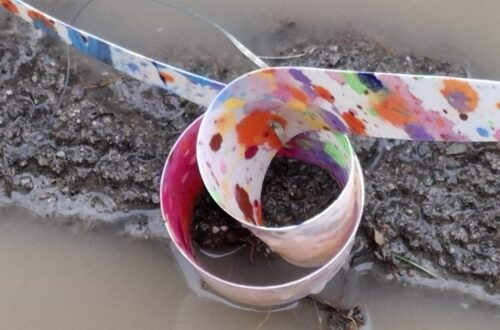
In works such as the series Desde la Tierra, made with textile remnants recovered from decoration stores, the aesthetic dimension intertwines with an ecological and ethical discourse. The constructed surfaces evoke cracks, abysses, and falls, accompanied by metal structures in the shape of airplanes that recall topographies seen from above, thus returning a landscape interweaving gesture, matter, and memory. Here too, the principle of transformation of fabric into refuge and protection returns, not only physical but also imaginary and symbolic.
Weave Unfold Pleat therefore does not merely present a retrospective, but affirms the coherence of a research that, while traversing different media and languages, finds in textiles the most fertile ground to express a radical, sensitive, and ironic vision. The exhibition restores Miriam Medrez fully to that genealogy of women artists who have made the female condition into a universal archetype, and who have been able to transform the body into landscape, refuge, and collective metaphor, inscribing their work within the field of a sculpture capable of becoming narrative, memory, and shared language.


Miriam Medrez (Mexico City, 1958) studied Fine Arts at the National Autonomous University of Mexico (UNAM) and at Concordia University in Montreal, Canada; she worked as a teacher at the University of Betzalel, Jerusalem, Israel, and at the Center for Higher Design Studies of Monterrey (CEDIM), Monterrey, Mexico. Since 1985 she has lived in Monterrey, Nuevo León, a city where she has conceived, developed, and consolidated much of her work as a sculptor. Her career is characterized by a constant and tireless creative search that has spanned different fields and media, conferring a distinctly multidisciplinary character on her production. She has experimented with numerous techniques with notable executional quality and craftsmanship, participating in solo and group exhibitions in Mexico, the United States, Venezuela, Austria, Denmark, France, Italy, Ireland, and Portugal.

She has received several awards and recognitions, including 1st Prize in Sculpture at the IV Monterrey Femsa Biennial and the Institutional Stimuli of the National System of Creators FONCA/CONACULTA. Among her most recent exhibitions are Hilvanando Identidades at the Querétaro Art Museum, Querétaro, and at the Capilla del Arte of the University of the Americas, Puebla; The eyes cannot see at Crearte by ICBC, Ensenada, Baja California; at the Del Desierto Museum of Finance and Public Credit, Mexico City; and at the MARCO Museum of Monterrey with Asalto de Memories and The Structure of the Skin.