
ON RELATIONSHIP: INTERTWININGS AND BONDS IN THE ART OF GIULIA NELLI
| by Barbara Pavan |

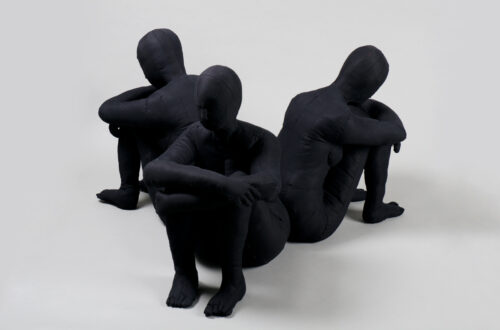
Giulia Nelli’s artistic path began concretely and definitively with her encounter with pantyhose, a ductile and elastic material that facilitates the amplification of gesture and obeys a precise, meticulous manual skill aimed at surpassing already experimented canons. It also constitutes, symbolically, a medium deeply and intimately anchored to the feminine universe and to the social and cultural evolutions that have affected it over the decades. Above all, pantyhose adhere perfectly to the function of Nelli’s artistic practice, as she unravels and re-knots them, frays them, intertwines them – and this articulation and disarticulation perfectly evokes the complexity of human relationships, which are the origin and essence of her research. She translates them in her works through an aesthetic approach that alternates fullness and emptiness, light and shadow, different densities and transparencies.

Zygmunt Bauman defined ours as a liquid society, born from a culture of consumption and immediate satisfaction of needs and desires, in which everything is always available, rapidly consumed, and promptly replaced. In an era in which the sense and value of time are misunderstood, cultivating relationships appears anachronistic: in the technological age, connections – or rather virtual relationships – seem far more adequate. Unlike the former, they are easy to establish and just as easy to interrupt. This scenario carries within it an ambivalence: we establish relationships to escape the sense of vulnerability and loneliness, yet, in wanting to preserve our freedom intact, we prefer fragile bonds whose extreme precariousness, in turn, generates a sense of insecurity.

This tension between attraction and repulsion, between hope and fear, is summarized by the artist in the Italian binomial “legàmi/légami” (“bonds/ties”): Nelli explores the plurality of relational declensions between people, their mutability, their persistence in memory, the emotional charge they develop, and their influence on the individual’s inner life — up to the network that composes a community and, not least, the system of relationships between human beings and the environment in which they live.

Since 2018, through the series “Isole” (“Islands”), the artist has examined the need to open up to confrontation with the other, overcoming the perimeter of one’s fears. A theme that, with the advent of the long lockdown period, also combined with a rediscovered value of time as a precious element for an idea of community—one that has become blurred due to processes of globalization, urbanization, and the expansion of virtual social networks. (…)

Read the full text in ATLAS / CHAPTER ZERO, available for order here…