
ELSEWHERE IS ALREADY HERE: REENA SAINI KALLAT AT RICHARD SALTOUN GALLERY, LONDON
Richard Saltoun Gallery presents Elsewhere Is Already Here, the first solo presentation in London by Indian artist Reena Saini Kallat (b. 1973, Delhi). Included in the exhibition are new works with key monumental pieces from the last decade of her practice. The exhibition explores the unstable boundaries through which we divide and organise the world, and the forces that continually move beyond them. Kallat’s work reveals a world in which no territory, organism or community exists entirely in isolation, while drawing attention to the unequal structures of power and access that shape these relationships.
Spanning sculpture, installation, drawing and assemblage, Kallat’s work traces the movement of ecological networks across political and geographic boundaries, examining the tension between systems designed to separate and those that cannot be restrained. Elsewhere is Already Here extends Kallat’s ongoing engagement with borders, migration and ecology, bringing together works that question the systems through which territory, resources and belonging are defined.
The exhibition runs through 19 December 2026.
About the works
The exhibition is anchored by three monumental works: Woven Chronicle (Water Stress), River Boundaries Break the Sound of Silence Between Them and Earth Families. Across these works, electrical cable functions simultaneously as conduit and barrier, recalling networks of communication and energy while evoking territorial fences, borders and infrastructures through which power is organised.
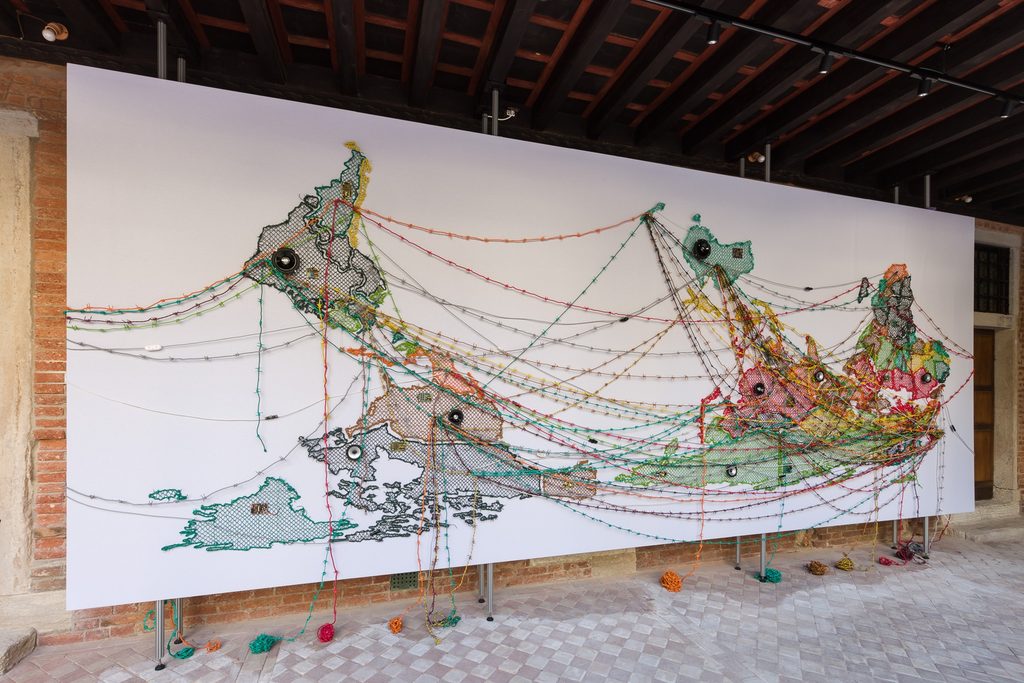
In Woven Chronicle (Water Stress), Kallat re-maps the world according to water availability, consumption and demand, replacing familiar political geographies with a cartography shaped by ecological pressure. Woven from electrical cables assembled as barbed wire, the work exposes the unequal distribution and consumption of water, while revealing how water scarcity and consumption exceed national boundaries and bind distant places together. Earlier iterations of Woven Chronicle have been exhibited internationally, including at the Museum of Modern Art, New York; Art Gallery of New South Wales, Sydney; and Institute of Contemporary Art, Boston.
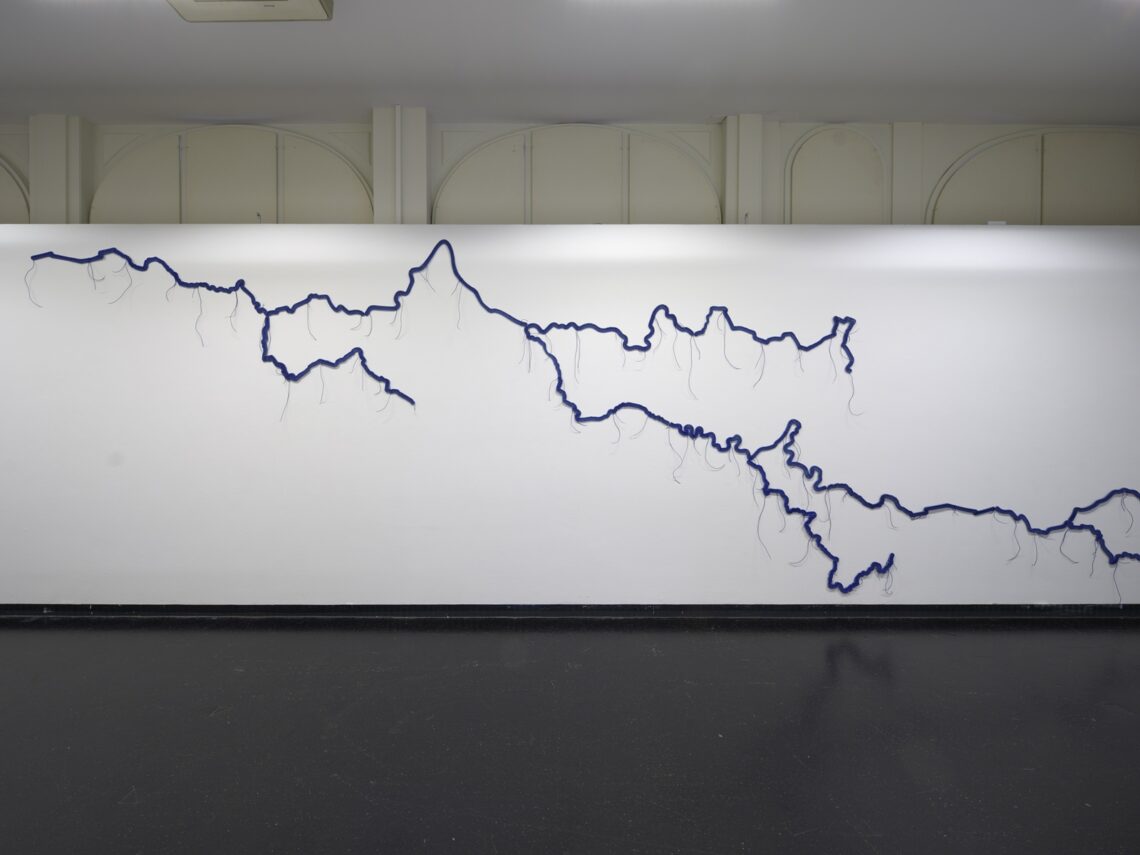
This tension between political division and natural systems is also central to River Boundaries Break the Sound of Silence Between Them. Electrical cables trace borders where rivers are shared by countries in conflict, transforming a material associated with separation into one of connection. The work reflects the impossibility of containing rivers within the political territories drawn around them and was previously exhibited at Kunstmuseum Thun, Switzerland, at Kallat’s solo exhibition Deep Rivers Run Quiet (2023).
These concerns are revisited in innumerable other works. In River Morphologies, the dessicated terrains are overlaid with laser-cut soundwave forms derived from archival field recordings of the rivers’ original sounds. If rivers expose the inadequacy of political boundaries, Aqua Atlas reveals the unequal relationships hidden behind them. The work translates data concerning humanity’s water footprint into a series of geometric compositions, shifting the familiar language of the map into abstraction.
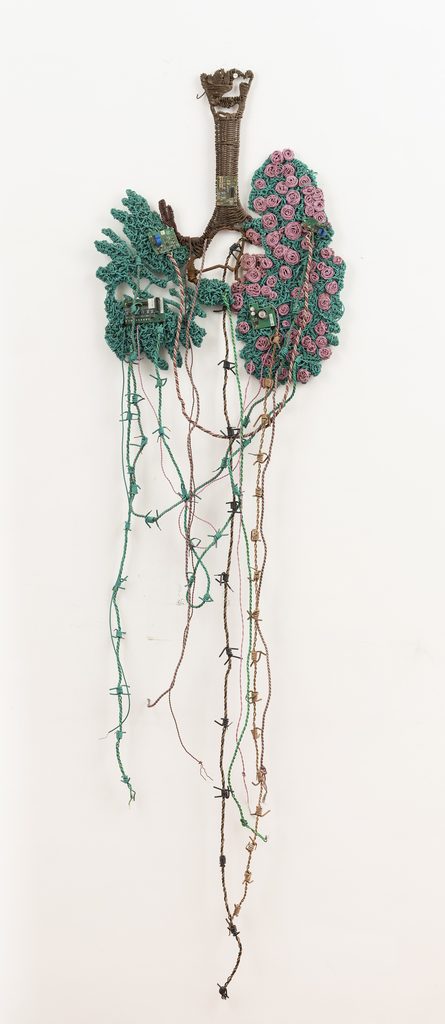
In Earth Families, Kallat extends this inquiry into ideas of kinship and belonging, moving beyond human, national and territorial categories to foreground wider forms of ecological interdependence. Additionally, in Siamese Trees (Pine-iscus), trees associated with nations divided by contested borders are conjoined through woven electrical cables. Here, pine meets hibiscus, creating hybrid forms that disregard the political separations assigned to them.
About the artist
Reena Saini Kallat (b. 1973, Delhi, India) lives and works in Mumbai. Her multidisciplinary practice explores borders, migration, identity, ecology and the movement of people, materials and resources. Her work has been exhibited internationally in solo and group exhibitions at institutions including The Museum of Modern Art (MoMA), New York; Tate Modern, London; Kunstmuseum Thun, Switzerland; Institute of Contemporary Art, Boston; Bhau Daji Lad Museum, Mumbai; Compton Verney, UK; Firstsite, UK; Musée National des Arts Asiatiques – Guimet, Paris; Manchester Museum; and Vancouver Art Gallery, amongst several others.


